The standout talk for me at ATTD2024 was by Doctor Dessi Zaharieva on making exercise guidelines practical. It was standout for a couple of reasons. Firstly, it was a great talk, accessible to people of all academic levels and secondly, it was practical: the guidelines presented can be used by people with type 1 diabetes easily and without a pocket calculator/slide rule (am I aging myself with that reference?) on hand.
You may also recall that, back in November, I did a post on a talk by John Pemberton at ISPAD2023 (also mentioning Dessi) on the same topic.
This blog will look to bring together the two talks (and my own experiences running the Blue Circle Cycle Club) so others can use the knowledge and, hopefully, it will encourage them to incorporate exercise into their type 1 management routine. The focus will be on bike riding but feel free to follow the links for tips on other forms of exercise.
What Did John (and Dessi) Say at ISPAD 2023? A Recap of my Previous Post
In my previous post, I had the following key points:
- Exercise, as it increases your heart rate, makes insulin stronger and last longer as it gets to circulate around the body more before it is broken down by the liver and kidneys
- Aerobic exercise tends to lower blood sugar levels which, combined with the ‘amplified insulin’ can make hypoglycemia more likely
- Exercise has many benefits and Dessi expresses it really well in just one slide

- A Continuous Glucose Monitor (CGM) is really useful when exercising as it gives you near-real time feedback on your blood sugar levels, allowing you to address any hypos before they become an issue. For people not using CGMs, Hypoactive suggests “test your blood glucose (BGL) at least twice, 15-30 minutes apart before you exercise.” to understand the direction you are trending and regularly test during exercise.
- Non-Looping Food Strategy: Eat before exercise to bring you up to around 7-10mmol/L (126-180mg/dL) to act as a buffer against going low
- Non-Looping Insulin Strategy: Reduce basal insulin by 20% leading up to exercise, adjust in subsequent rides if too high/low
- Looping Food Strategy: None. Cannot eat to raise BGLs as the loop will counter it, unless you deactivate the loop and follow the MDI/Non-Looping strategy
- Looping Insulin Strategy: Raise BGL target level to, say, 8mmol/L (144mg/dL) and set system to ‘exercise mode’ if available when exercising
- Roughly speaking, if you are at your target level when exercising, take around 15g of carbohydrates every 20 minutes to maintain it. If you are above but dropping fast, take the same, if you are below and heading upwards take the same and if you are below and flat or heading downwards, take more than 15g of carbohydrate per 20 minutes
- Hypoactive suggests monitoring glucose levels for at least 24 hours after exercise and Diatribe recommends reducing bolus insulin by 50% for meals or snacks up to two hours after exercise.
What is Dessi Saying at ATTD2024?
Dessi, via Dana Lewis, generously gave me a copy of her slides so I have much clearer images for this blog than my original tweets.
I will focus on presenting the ‘practical’ slides than give the full presentation.
Starting Glucose
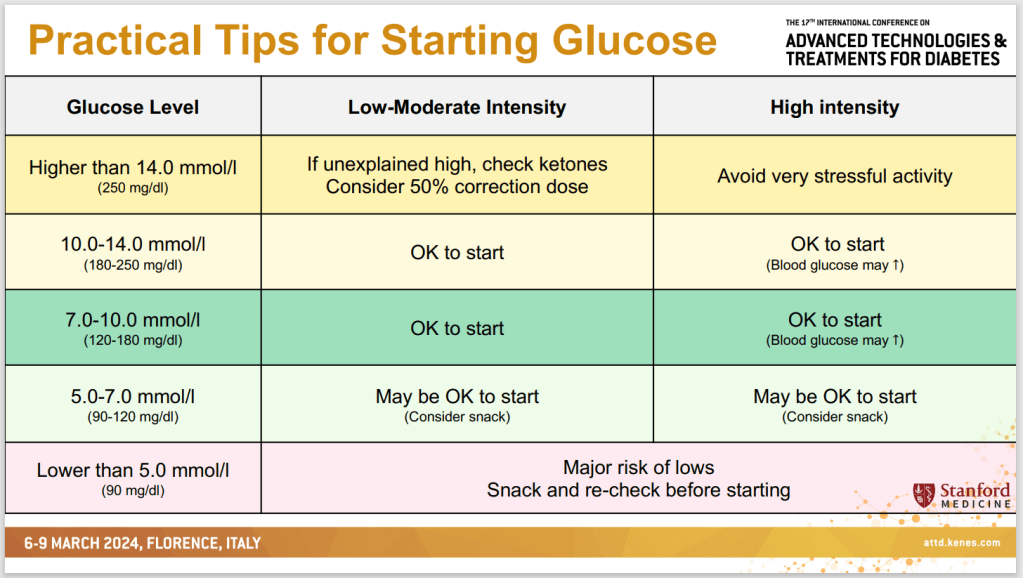
Bike riding is considered a Low-Moderate Intensity exercise so the suggestion is to start between 7-14mmol/L (126-252 mg/dL) which is in broad agreement with the previous advice.
Mealtime Insulin Before Exercise

In my previous blog, Diatribe had suggested reducing bolus injections by up to 50% leading up to exercise and we see here this is in broad agreement, especially with Low-Moderate exercise.
Basal Insulin Before Exercise

For non-loopers, John’s position was to reduce basal insulin by about 20% before exercise. Arguably Dessi’s position is not as strong saying a 10-20% reduction is only needed if the day is unusually active but, with John’s suggestion to adjust based on experience, we can see there is a middle ground between the two positions.
Snacks During Exercise (CGM)

Again, we see broad agreement with John’s talk. In terms of what to do below target, the softer language here allows room for John’s ‘maintenance carbs’ that he suggests (around 15g every 20 minutes). I should note here that my experience has been that, while I initially needed a protein bar before exercise to stave off lows, as my stamina/fitness improved, the need to do so has diminished. For example, the 10km/6 mile ride I did today I did without breakfast and no protein bar and stayed flat.

Dessi also suggests a backup glucose monitoring kit (good idea, especially for longer exercise intervals) and makes the excellent point that, as CGM can lag the true BGL value, a drop in BGL should be attended to as early possible.
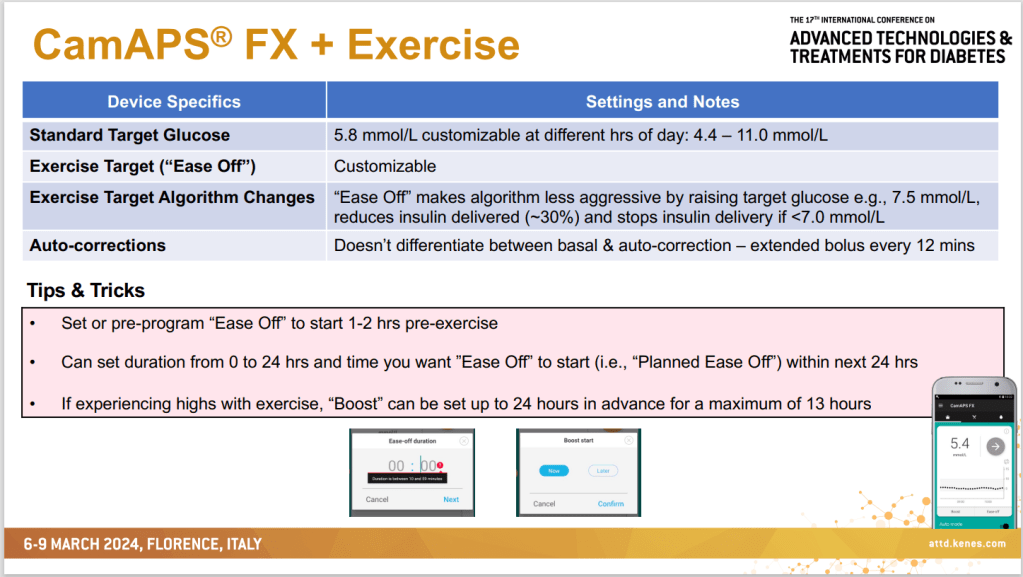
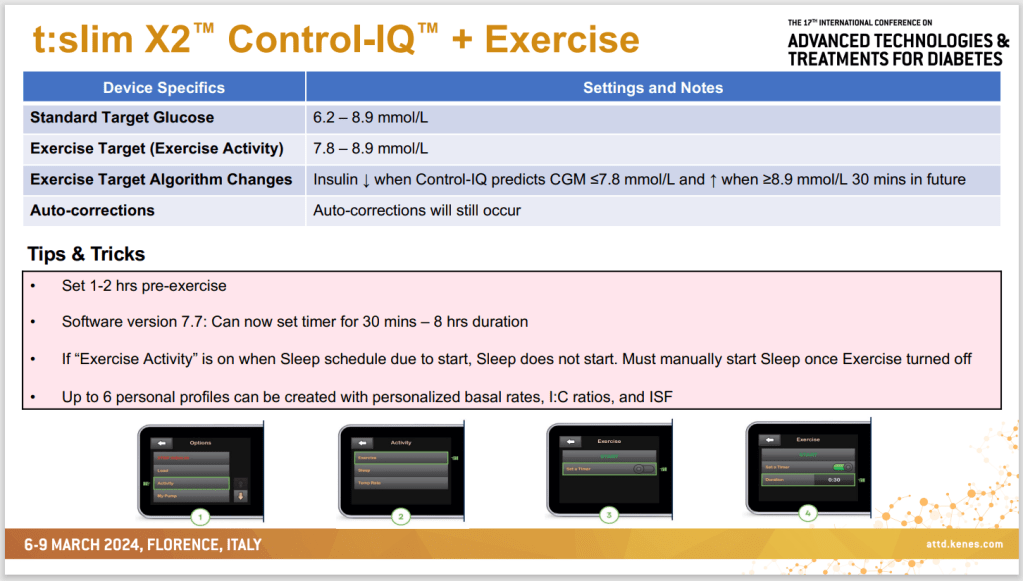
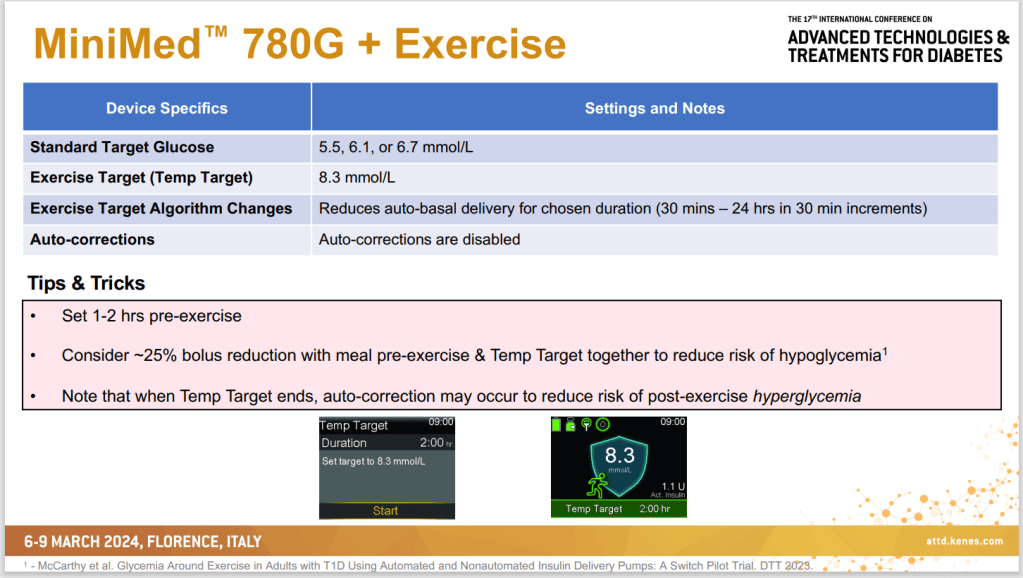
Looping Settings For Exercise
John also had a table of pump settings (screenshot in my previous article) and Dessi’s are in broad agreement. As they are friendlier to read, I am including hers here (sorry John).

Dessi’s Summary and What Really Happens
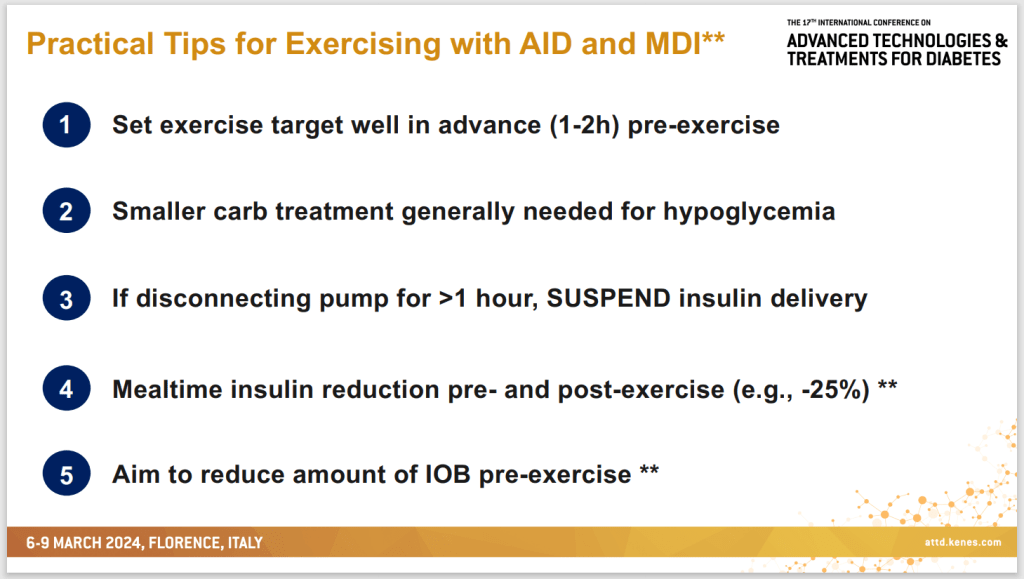
This was her summary slide combining tips for loopers and non-loopers. Again, nothing too unusual here, compared to previous tips but all good information.
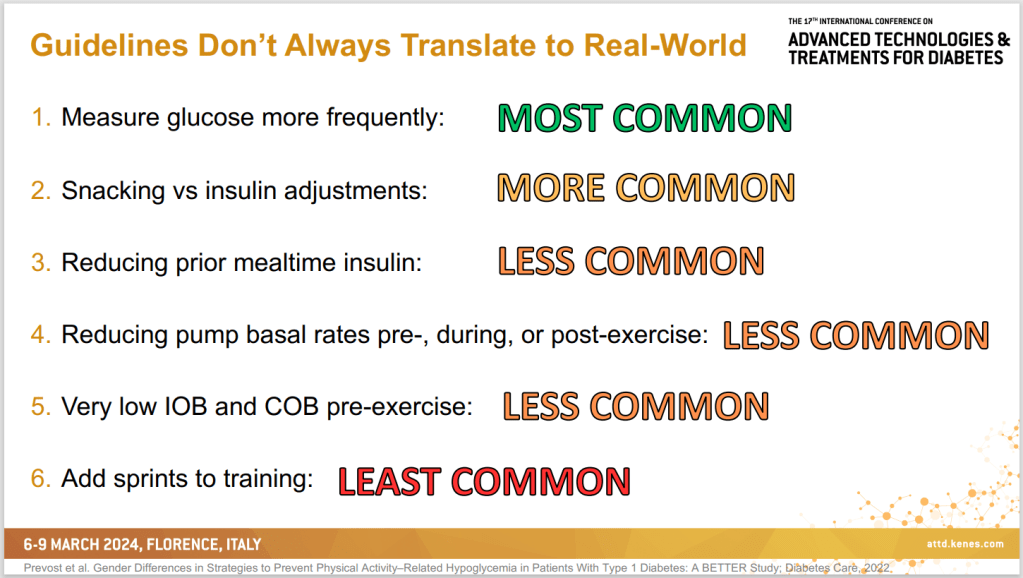
Of course, as she was going through all the suggestions I was thinking “yes, I will do that” and “no, I will not bother with that” and, as if she was reading my mind, she showed the slide above which aligned perfectly with my thinking.
Points 3-5 all relate to pre-exercise guidelines. I had dismissed these because, with a family, I cannot guarantee exactly when I will be starting exercise. For me it makes more sense to start following guidelines when I am about to ride, making points 1 and 2 the most relevant/practical.
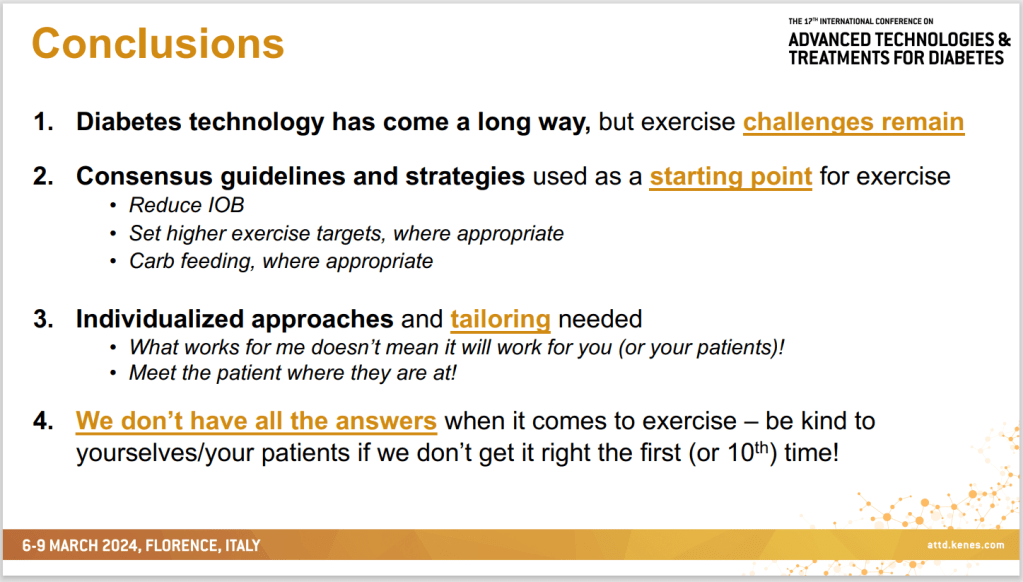
Her conclusions align to what many of us with type 1 diabetes concluded long ago when it comes to managing our blood glucose levels: Academic guidelines are well and good, but everyone’s diabetes is different, and we need to work out what works for us.
Things to Take on the Ride
From my own riding adventures, these are the things I keep on me while riding. For storage, you can pick up very affordable bike storage bags/panniers on the usual sites (Amazon, eBay, etc.)
- A phone so you can monitor your CGM levels and/or a blood testing kit if you are not using a CGM. A phone can also be used to track your riding time and distance via apps like MapMyRide and Strava.
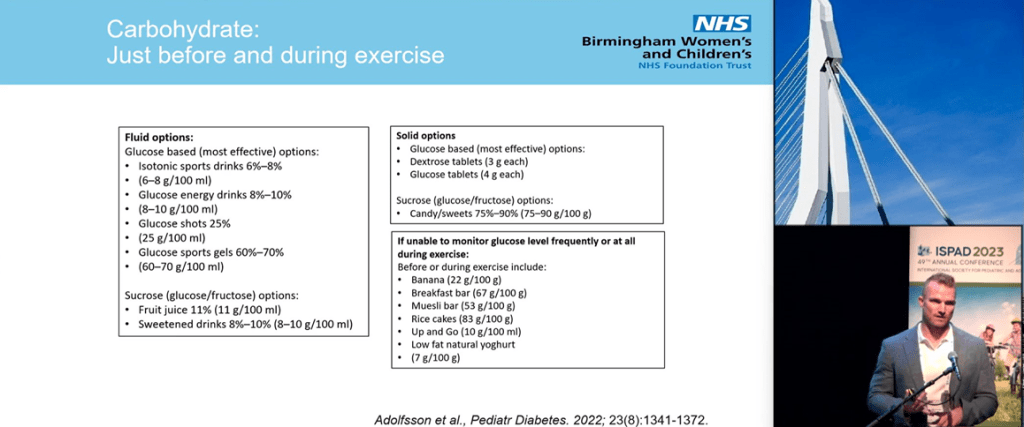
- Hypo snacks (long and short-acting) to treat hypos and stave them off during exercise. John had some excellent examples
- A medi-bracelet so, if there are issues, it can be quickly identified that you are a person with type 1 diabetes. Like the bike storage bags, these can be easily picked up online
- Sunscreen, especially if you are cycling in the sun
- Hydration: A riding bottle and bottle holder should be part of the bike or, you can also get wearable water bladders if you want to drink hands-free
- Appropriate clothing: Some bike shirts have zippable pockets for storage or otherwise, simply clothes which allow movement and you will not get too hot in. I have picked up some excellent bike clothing and accessories at second-hand clothing stores
- A smart watch: This is more a nice-to-have but I personally find it easier to check my BGLs on the watch by tapping it to my chin, than messing with the phone which is usually tracking the ride and not showing my BGLs
Bringing Together the Strategies for the Ride
Along with bringing the above along, here is the overall strategy summary for a morning bike ride, like those of the Blue Circle Cycling Club using my last post’s strategy as the foundation. Also note that, in the real world, people do not do all these things so work out which ones work for you.
Glucose Levels
- Non-Looping: 1-2 hours before, have a Low GI breakfast to raise glucose levels with a reduced bolus (around 25-50%) to minimise insulin on board AND/OR reduce basal rates (10-20% reduction) to allow blood glucose levels to rise to around 7-14mmol/L (126-152mg/dL)
- Looping: Skip breakfast, and 1-2 hours before set a higher loop target (around 8mmol/L = 144mg/dL) OR disable looping and follow the Non-Looping approach
During the Ride
- Monitor glucose levels and, if they are dropping, eat a snack to counteract the trend.
- If you already know how long you can exercise before levels start to drop, eat snacks accordingly. If unsure, start with eating around 15g of carbohydrate every 20 minutes of exercise.
After the Ride
- Have a snack/coffee post-ride, especially if you are driving home
- Monitor blood glucose levels for up to 24 hours
- Reduce bolus rates by 25-50% up to two hours are the ride
- Make any necessary adjustments to the approach for the following week.
 The Practical Diabetic
One thought on “ATTD2024: Making Exercise Practical For Type 1 Diabetes”