A Sick Day Plan Template

I just put together a Sick Day Plan/Guide for my Family in Case I am unconscious. I thought I would share it so others can craft it to make it their own. The guidelines are taken from the Australia Diabetes Education Association (https://www.adea.com.au/wp-content/uploads/2020/09/Consumer_01_10.pdf)

I have written them for someone with a pump (because I have a pump) and while the administering of insulin can be done with a pump, in an emergency, I made the call that a family member would be more capable of injecting insulin than checking if a pump still had insulin and using it to give a bolus.

I am not a medical professional so I strongly recommend running your version of this plan past your health care team before using it.

The Template

Sick Day Plan

Contacts

RelationshipNameContact Number
Partner<Partner Name><Partner Phone Number>
Endocrinologist<Endo Name><Endo Phone Number>
Diabetes Educator<DE Name><DE Phone Number>
GP/Family Doctor<GP Name><GP Phone Number>
Dentist<Dentist Name><Dentist Phone Number>
Cardiologist<Cardiologist Name><Cardiologist Phone Number>

What To Do When Sick/Unconscious (Looping Insulin Pump Plan)

  • FAMILIARISE YOURSELF WITH THE INSTRUCTIONS BEFORE ACTIONING THEM
  • If feeling unwell, Leon is unconscious, or BGL > 15mmol/L (270mg/dL) for more than 2 hours
  • Check Blood Glucose Levels (BGLs) and Ketone Levels
  • Continue to drink (0.5-1 cup of fluid per hour) and eat if possible (15g carb per hour)
  • If BGLs greater than 10mmol/L (180mg/dL)
    • Low carb intake and use insulin (<Inset enough to get you down to, say, 4mmol/L (72mg/dL))
  • If BGLs less than 4mmol/L (72mg/dL)
    • Take fast acting carbs
    • Check BGLs every 15 minutes and treat until above 4mmol/L (72mg/dL)
  • If ketones 0.6 – 1.5mmol/L (60 – 150 mg/dL)
    • Change pump site
    • Check BGL/ketones every hour
    • Give 20% of your Total Daily Dose (TDD) of insulin every two hours.
  • If ketones >1.5mmol/L (150mg/dL)
    • Give 30% of your TDD every two hours
  • Otherwise
    • Check BGL/ketones every 2 hours
  • If vomiting stop taking Metformin and SGLT2i’s

NB: Plan may need adjustment if not running a looping pump.

Liquids With Carbs

  • Fruit juice (10g/100mL)
  • Tea with sugar (5g/teaspoon)
  • Milk (5g/100mL)

Liquids Without Carbs

  • Water
  • Diet coke/pepsi
  • Diet cordial
  • Stock
  • Tea without milk and sugar

When To Seek Medical Attention

  • Leon is unconscious
  • Blood Glucose Levels over 15mmol/L (270mg/dL) and not coming down after two insulin treatments
  • Ketone levels above 1.5mmol/L (150mg/dL) and not coming down after two insulin treatments
  • Low BGLs (<4mmol/L (72mg/dL)) even after two hypo treatments
  • Persistent vomiting (>4 hours) or stained with red/green/yellow
  • Cannot follow sick day action plan
  • DKA symptoms
    • Nausea/Vomiting/Stomach Pain
    • Increased thirst
    • Increased urination
    • Rapid, short breathing
    • Fruity smelling breath
    • Drowsy, weak, or confused
    • Rapid heartrate
    • Headache
    • Blurred vision
    • Dry skin

Note: Leon should not drive if he needs medical attention

How to Test Blood Sugar Levels

  • FAMILIARISE YOURSELF WITH THE INSTRUCTIONS BEFORE ACTIONING THEM
  • Get the black diabetes kit (usually in the blue diabetes bag in the craft cupboard)
  • Take out the Genteel lancing device, Test Strip container (remove a test strip), and the Glucometer
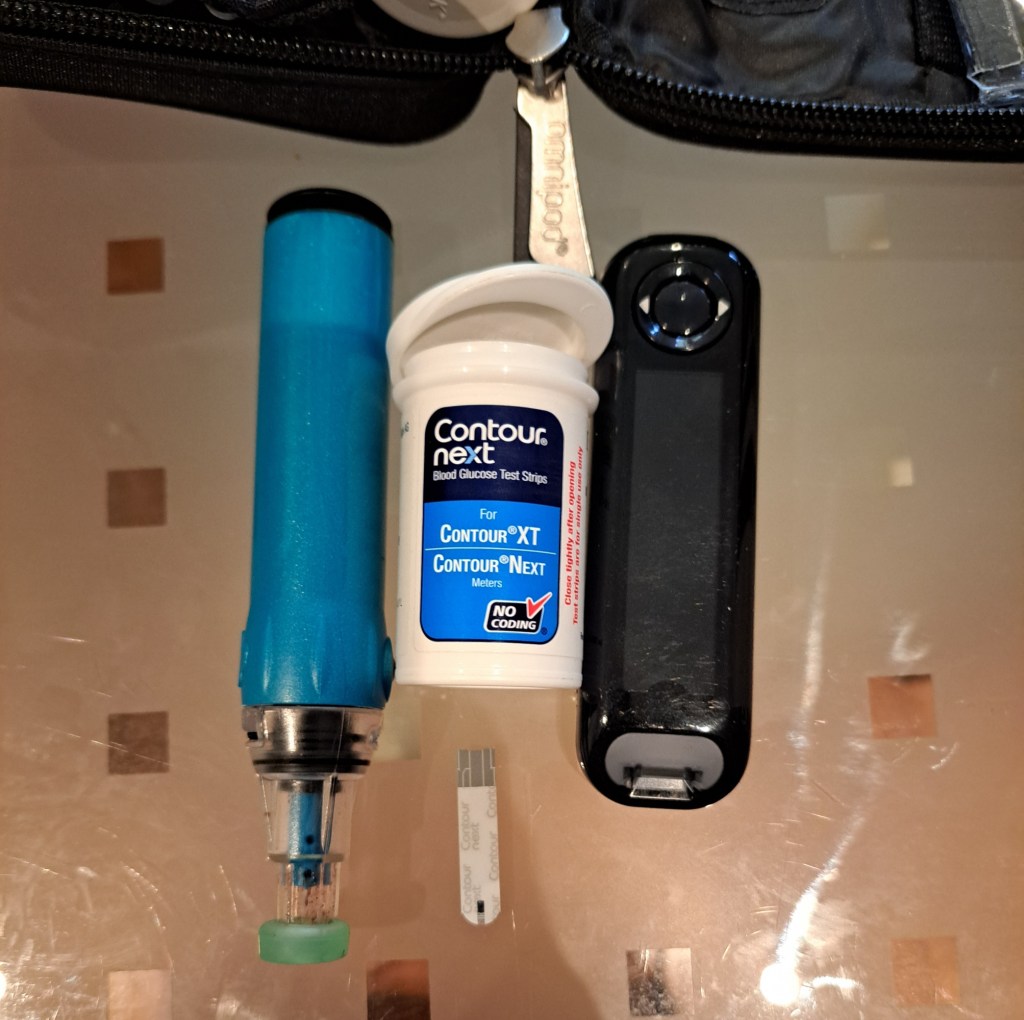
  • Place the grey end of the test strip into the glucometer where the slot is
  • Place the Genteel against a finger tip
  • Press and hold the black button. You should see blood appear at the site in contact with the fingertip
  • If you fail to draw blood push the plunger back down until it clicks and try again
  • Dip the inserted test strip into the blood until the glucometer beeps
  • Wait a few seconds and it will tell you Leon’s blood glucose level

How to Test for Ketones

  • FAMILIARISE YOURSELF WITH THE INSTRUCTIONS BEFORE ACTIONING THEM
  • Get the black diabetes kit (usually in the blue diabetes bag in the craft cupboard)

This image has an empty alt attribute; its file name is 20231125_155424.jpg

  • Take out the Genteel lancing device, a Purple Test Strip in foil, and the Ketone Glucometer
  • Place the black striped end of the test strip into the glucometer where the slot is
  • Place the Genteel against a finger tip
  • Press and hold the black button. You should see blood appear at the site in contact with the fingertip
  • If you fail to draw blood push the plunger back down until it clicks and try again
  • Dip the inserted test strip into the blood until the glucometer beeps
  • Wait 10 seconds and it will tell you Leon’s blood ketone level

How to Give a Glucagon Injection

Only to be done if the blood sugar levels are less than 3mmol/L (52mmol/L) and unresponsive/unable to eat/drink.

NB: I could find no good guidance on when to use glucagon other than ‘when low’ so feel free to adjust the 3mmol/L level to one which works for you and your health care team.

The glucagon kit can be found in the blue diabetes bag in the craft cupboard in the front pouch.

Watch the video “How to do a glucagon injection” video on YouTube by University College London Hospitals NHS Foundation Trust (https://www.youtube.com/watch?v=9dDJQPHJq3w)

How to Inject Insulin when Leon is High (>15mmol/L (270m/dL))

  • FAMILIARISE YOURSELF WITH THE INSTRUCTIONS BEFORE ACTIONING THEM
  • Get an orange injection pen from the fridge (butter compartment or the grey cooler bag)
  • Get a needle from the fridge (butter compartment)
  • Remove paper cover from bottom of needle
  • Remove top from insulin pen
  • Screw the needle onto the insulin pen and remove the two needle caps
  • Dial 1 unit and press the dialler down until you see insulin come out of the needle
  • Dial the units indicated above
  • Push the needle into a fatty area of the body e.g. belly
  • Press the button down and leave it in while you count to 10
  • Remove the injection pen from the injection site and cover the insulin pen with the pen’s blue cap to hide the needle tip

Exercising with Insulin

One of the highlight talks for me at ISPAD 2023 was by John Pemberton who spoke on managing exercise when you have type 1 diabetes. This was particularly relevant to me because I have just started cycling again and want to start up a type 1 cycling club in Sydney where I live. He had a wealth of information on exercising safely and, combined with a few other resources I have found, I thought I would consolidate it here for reference.

Given my interest is in the context of a weekly morning cycle for people with type 1 diabetes, the blog will be geared towards this. If this is not what you are looking for, or even if it is, I strongly encourage you to consult an exercise physiologist and your health care team before embarking a change of exercise, especially if you are insulin dependent.

Why is Exercise a Problem for People with Type 1 Diabetes?

The answer is because, in the short term, it makes managing insulin and blood glucose levels harder. For a disease which is already a full-time job for many, making that job harder is not particularly desirable. No one wants overtime for a job that is 24-7. The fear of being in the middle of exercise and having a hypo was consistently mentioned at EASD 2023 and ISPAD 2023 as a psychological blocker for doing more exercise. Dessi Zaharieva summed it up well with this.

While exercise obviously uses up energy, another complication is the increased heart rate makes insulin more effective: this was explained by John Pemberton as being because it accesses more of the body before getting broken down by the liver and kidneys.

So, without smart management we have glucose leaving the blood to feed an exercising body and the tool of choice for doing this, insulin, is now amplified.

On top of this, different exercises affect the body differently. Intense, anaerobic exercise can lead to an increase in blood glucose levels, with the liver dumping glucose into the blood to help the body keep up, while less intense aerobic exercise generally lowers the blood glucose levels.

We can see why hypoglycaemia may be a concern and why people reliant on insulin may consider it all a bit too hard.

Is Exercise Important?

It is hard to find anyone who does not acknowledge the value of exercise to long term health. At every conference there is always an academic who quips that if they could put the health benefits of exercise into a pill, they would win the Nobel prize for Medicine. In the specific case of insulin, exercise lowers insulin resistance and reduces the risk of a variety of diseases. Dessi Zaharieva also put up a great slide at ISPAD 2023 highlighting the benefits.

The World Health Organisation has clear recommendations for exercise which I expect many of us in the Western World spectacularly fail to heed.

While a weekly bike ride is unlikely to tick the WHO box in itself, it is a step in the right direction.

Tools for Exercising Safely

In my opinion, the tool that makes the biggest difference for being able to exercise safely is a Continuous Glucose Monitor (CGM). This tells you what your glucose level is throughout exercising and which direction it is heading, giving you warning if your levels are going too low. In the case of cycling, this means wearing an integrated watch to display the blood glucose level, or having a mounted device, such as a CGM reader or your mobile phone.

If you do not have a CGM, finger pricking can be used. Hypoactive suggests “test your blood glucose (BGL) at least twice, 15-30 minutes apart before you exercise.” This will give an indication of blood glucose level and the direction is it going.

If you are going low during exercise, you will need to treat it, which means having a readily available source of glucose is important when exercising. For cycling, these can be carried in a bike bag/pannier, or in your pocket.

If the worst case scenario does happen, and you go unconscious due to a low, wearing a medi-bracelet also makes a lot of sense so you can receive treatment as quickly and efficiently as possible.

If the UV levels are going to be high while exercising, it also makes sense to wear sunscreen. Sunburn can also play havoc with glucose levels.

Depending on how long the exercising goes on for, supplementary food to eat along the way may also make sense.

A cheeky snack in preparation for exercise can also be useful but the strategy employed is strongly dependent on how you receive insulin.

Exercise Preparation: Multiple Daily Injections (MDI)

For each of the preparation sections, I will break down the approach into “Food Strategies” and “Insulin Strategies”.

MDI Food Strategy

In the case of MDI, the food strategy is to eat food such that the blood glucose level before exercise is, say, between 7-15 mmol/L (126-270 mg/dL) (taken from My Way Diabetes), providing a buffer for when the exercise brings blood sugar down. Sports Dieticians Australia set a more conservative range of 7-10 mmol/L (126-180 mg/dL) for exercise going over 60 minutes. Diatribe recommends reducing bolus rates by 50% to get there. John Pemberton had a table of suggested foods for the purpose of getting ready for exercise.

Sports Dieticians Australia are more general in their recommendations suggesting simply low GI foods.

MDI Insulin Strategy

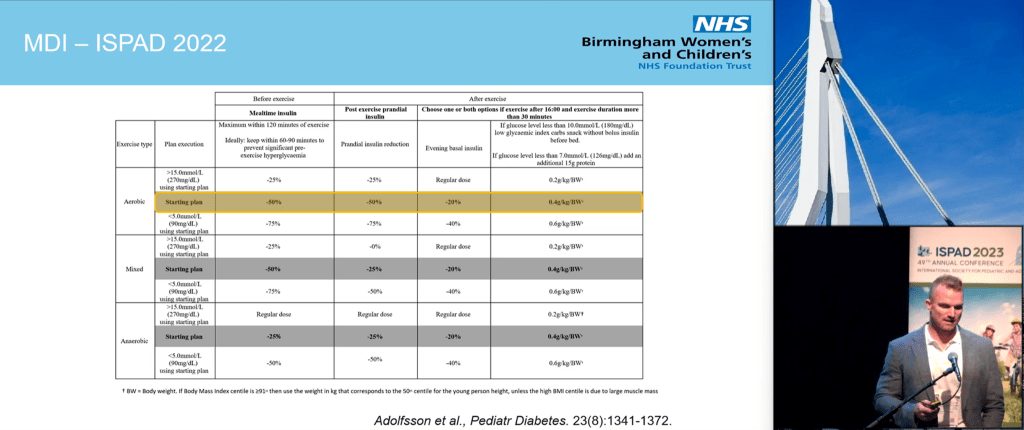
The insulin strategy is to reduce the basal insulin leading up to exercise, raising the blood sugar level. Diatribe recommend a 20% reduction in basal rates for exercise of more than 40 minutes. John Pemberton also had some thoughts on this.

In the case of cycling, this is generally considered an aerobic activity. In the table you begin reducing bolus rates by the amounts for pre- and post-exercise in the “Starting Plan”. If you find you end up too high or too low, you can adjust by moving to the appropriate adjacent plan in the table.

Exercise Preparation: Non-Looping Pump

Pump Food Strategy

The food strategy for pumps is the same as MDI i.e. eat food to temporarily raise blood sugar levels prior to exercise, modifying bolus rates, as needed.

Pump Insulin Strategy

The main difference with the Pump Insulin Strategy to the MDI one is the ability to set temporary basal rates. This gives the ability for some fine adjustment, which is harder with MDI.

Exercise Preparation: Looping/Automated Insulin Delivery (AID)

Looping Food Strategy

Eating food to raise blood sugars does not work with looping because the system automatically raises insulin levels to counter it, regardless of what is declared and bolused for. This means, by the time you are ready to exercise your body has plenty of insulin on board, which the exercise will supercharge, raising your risk of going low. Therefore, the strategy here is, for a morning ride, to skip breakfast.

To use food to raise blood sugars, the loop needs to be deactivated and we can follow the Pump Food Strategy. In my opinion, the better option is to consider the insulin strategy.

Looping Insulin Strategy

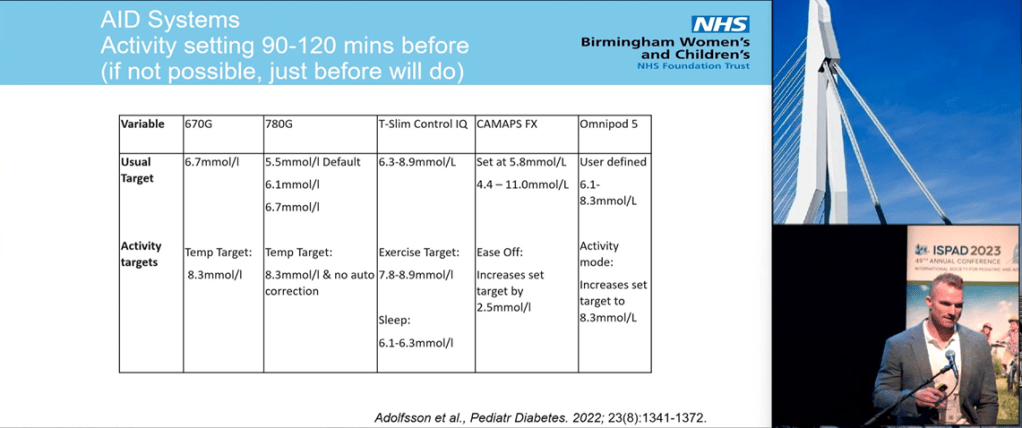
The target blood glucose level can be raised so the loop allows the blood glucose levels to naturally rise. This also minimises the amount of insulin on board (insulin in the body) which, in turn, minimises the risk of a hypo during exercise. Many looping systems also allow the declaration of exercise to modify how aggressive the loop is at reducing blood glucose levels. John had suggestions for most of the commercial looping systems.

Carbs During Exercise

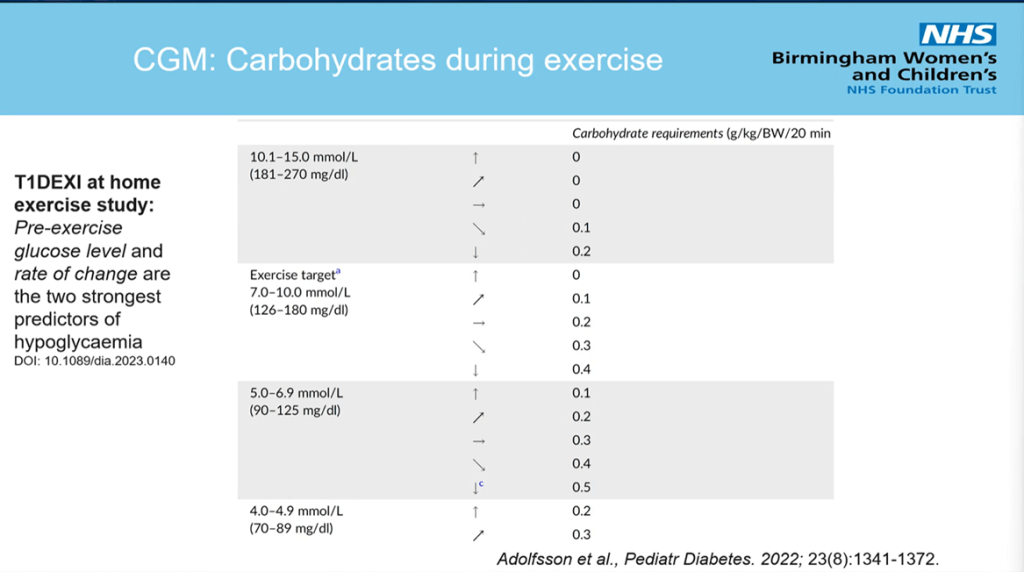
In my opinion this will be different for each person but there are guidelines out there. John Pemberton presented the following to calculate the carbs needed every 20 minutes.

g/kg/BW/20 min will be “grams of carbohydrate per kilogram of bodyweight to be taken every 20 minutes”. So, for example, if someone is 80kgs and their CGM level of direction suggests 0.2 g/kg/BW/20 min, this would mean 0.2*80g = 16g of carb every 20 minutes.

Sports Dieticians Australia suggest carbs are only needed every 60 minutes with aerobic exercise but do not go into details on the amounts.

Diatribe recommend for people on insulin pump therapy, to reduce the basal rate by about 50% (as a starting point) 1-2 hours before, during, and about one hour after exercise.

My thought is carry carbs with you and as soon as you see your glucose dropping, eat some. Examples of potential exercise raising food are above in the Carbohydrates: Just Before and During Exercise. Once you get a feel for your body’s carb cadence, you can get some carbs in ahead of the drop. Based on my own experience, as your body adapts to exercise and become more efficient, this cadence will change.

Post Exercise Tips

Hypoactive suggests monitoring glucose levels for at least 24 hours after exercise. The reason for this is muscles store glycogen which is consumed during exercise. To replenish glycogen stocks, glucose is taken out of the blood, increasing the risk of a hypo.

Diatribe recommend reducing bolus insulin by 50% for meals or snacks up to two hours after exercise.

My Strategy

For my weekly ride, as I am using a closed loop, I do not eat breakfast. While I initially set a higher target on my loop, I found it did not have much of an effect so I have stopped this. The one act which has made a huge difference in my blood glucose levels is eating a protein bar literally just before I ride. This act keeps my blood glucose levels flat for up to an hour.

Here is an example from literally this morning.

The rise just after 9am is the post-ride flat white coffee. While it always sends me up, this is my insurance policy for the car ride home again post-exercise lows. As we can see, my levels did drop into the high 3’s but, I have been this low before; this was happening to me even before I became insulin dependent so unless it goes below, say, 3.5 mmol/L (63 mg/dL) I do not give it too much attention.

Bringing It All Together For A Morning Ride

I will end this blog with a sample approach/preparation for an early morning cycle ride of, say, one hour.

Equipment

  • Functioning CGM
  • Mountable CGM reader or compatible watch
  • Rapid-acting hypo snacks for mid-exercise lows
  • Medi-bracelet
  • Sunscreen
  • Low GI snacks for maintaining healthy glucose levels during exercise

Glucose Levels

  • MDI: Low GI breakfast to raise glucose levels prior to exercise with a reduced bolus to minimise insulin on board AND/OR reduce basal rates to allow blood glucose levels to rise
  • Pump: Low GI breakfast to raise glucose levels prior to exercise with a reduced bolus to minimise insulin on board AND/OR set temporary basal rates to allow blood glucose levels to rise
  • Looping: Skip breakfast, set a higher loop target OR disable looping and follow the Pump approach

During the Ride

  • Monitor glucose levels and, if they are dropping, eat a snack to counteract the trend
  • If you already know how long you can exercise before levels start to drop, eat snacks accordingly

After the Ride

  • Monitor blood glucose levels
  • Reduce bolus rates by 50% up to two hours are the ride
  • Make any necessary adjustments to the approach for the following week.