Insulin Cooling Battles: BreezyPacks vs InsulinSaver

My last cooling battle was about four years ago, comparing Frio with BreezyPacks’ Breezy Basic. With a new product on the market, InsulinSaver’s “The Bag”, I thought I would see how the products stack up. To better understand how the BreezyPacks and InsulinSaver bags resist the heating of the insulin pens, check out that last cooling battle link where I explain the role of PCMs and how they work similarly to the Frio but without the soaking.

Disclosures

In the battle, I will be evaluating three cooling bags:

I also have a BreezyPacks bag called the “Breezy Plus” which is the same size as the Basic but with more active material. However, this is no longer on sale at BreezyPacks so I have excluded it from the comparison.

The Breezy Basic (and Plus) I bought at full price online and I bought The Bag at full price while at ATTD2025. I informed BreezyPacks of my intention to do a comparison and I asked if they had data on the Extra or would be willing to provide one for the comparison and they generously sent me one.

Neither BreezyPacks or InsulinSaver are paying me to do this comparison or offering any other incentive.

Comparing the Bags

Website Price (ex. Tax/Shipping)Capacity (Insulin Pens)WeightMax. Temp (C)
Breezy BasicUS$33.903176g41
The BagUS$41.96 (36.90 Euros)6368g54
Breezy ExtraUS$43.9010267g46

In terms of price, the pricing scales with capacity. For shipping to Australia, Breezy is about US$7 and for InsulinSaver it is about US$14.

The weight is a rough indicator of PCM material being used (the substance that resists the change in internal temperature) and we can see The Bag has the most, but it should be noted, we do not know InsulinSaver and BreezyPacks are using the same material. I also weighed my Breezy Plus which came in at 25.1g, similar to the Breezy Extra.

The Bag is also rated for a higher temperature than the Breezys but all fit within the range of most temperatures the bags are likely to be exposed to under normal conditions.

Measuring the Changes in Temperature

To measure the change in temperature, I used my oven on the lowest temperature setting. On the dial this is 50C but, as measured at the end of the experiment, the oven temperature was closer to 36C. This is within the limits of the bags and equivalent to hot summer day here in Sydney, Australia.

As you can see above, the three temperature sensors I used are all measuring the same temperature (this was at the end of the experiment, outside of their bags), within half a degree of each other (about a degree in Fahrenheit).

To replicate the conditions of an insulin pen as closely as possible, I put the probes inside NovoRapid insulin pen containers, retaining the empty glass reservoir inside.

These were then placed in the three bags being tested, one pen per bag.

Finally, these were placed in the oven on the same rack with the fan force function operating to try and maintain as even a temperature as possible.

It was then a case of recording the temperature every 15 minutes until the bags went over 30C or until three hours had passed, whichever came first.

The Results

This result genuinely surprised me. With the additional active material, I expected The Bag temperature to stay flat, relative to the others, but it closely trailed the Breezy Basic. In the final 15 minutes, the Breezy Basic started rising while The Bag was stable and I suspect this was due to all of the active material being liquified and no longer providing protection. Certainly, giving each bag the ‘squeeze test’, the Breezy Basic was almost fully liquefied, the Breezy Extra less so but still containing a fair amount of liquid PCM while The Bag felt almost completely solid. This is either a function of the larger amount of material or confirms InsulinSaver uses a different PCM to BreezyPacks.

I have a hypothesis why the Breezy Basic and The Bag performed similarly while the Breezy Extra heated up quicker and it has to do with the cross-sectional/exposed areas.

The sides of the bags are full of active material, but the ends are not. We can also see the cross-sectional area of the Breezy Extra is about double of The Bag (the top part of the Breezy Extra is also largely unprotected). With possibly less active material than The Bag and a larger unprotected area, this meant the Breezy Extra heated up quicker as the heat came through the unprotected areas. With the smallest cross-section, the Breezy Basic was the best protected from this attack and, even though The Bag’s end area was bigger, this may have been offset by the protection of the additional material on the sides. Ultimately though, after three hours, the Breezy Basic ran out of active material and the temperature started going up.

The good news is, even at these high temperatures/extreme conditions, the Breezy Extra lasted over an hour (and did not go past 31C for three hours), and the other two lasted over three hours.

Conclusions

For the ability to protect, and pen capacity, it is hard to go past The Bag but all three are robust at protecting their contents. For two-week trips, like the one I just did to Europe and the USA, I can see The Bag being used for my backup insulin pens and the Breezy Basic being used for the Fiasp penfills I use to refill my pump. If I need more capacity (or need a bag with a handle) the Breezy Extra is also a great option. I can see myself using the Breezy Extra as a standalone bag with refills, pump sets, backup pens etc. for overnight trips, a bag for work, or day trips.

Product Review: Drew’s Daily Dose Pen Needles

I got offered a box of Drew’s Daily Dose Pen Needles to try from the excellent Ash of Stripped Supply.

I had heard good things so I thought I would give them a go. My disclosures are:

The needles cannot be purchased from Drew’s web site but are purchased through the NDSS.

While I use an insulin pump and do not inject insulin, I do use Ozempic so I used the needles for that. When they ran out, I used the needles that came with Ozempic and a box of BD Ultra-Fine needles. Rather than weekly, I inject a scaled-down dose of Ozempic daily with a new needle, so it was not hard to go through the needle box.

Look and Feel

In the image above we have the Ozempic needle on the left, Drew’s needle in the middle and the BD needle on the right. As you can see, the design of the Ozempic needle and Drew’s needle are a lot similar than the BD needle. Looking at the packaging, the Ozempic needle is a NovoFine Plus 32G 4mm (same gauge and size as the other two needle types). The NovoFine Plus needles can also be purchased through an NDSS order but my understanding is supply can be problematic i.e. nonexistent.

Drew’s Claims

Drew makes a number of claims both on the box and on his web site. This seems like a good place to start the review.

Box Claim: Ergonomic

Ergonomic means “designed for efficiency and comfort in the working environment” which, in this case, presumably means when injecting. Certainly, I found the needles as comfortable on insertion as the other needles I used. Where it was slightly better was on holding the needle in the site for 10 seconds to allow the Ozempic to seep in. It is very easy for the injection pen to move around a little and, generally this did not hurt with the Drew needle, whereas there is sometimes pain with pen movement with the BD needle.

Box Claim: Reliable

I go through the entire box without issue but, then again, I can go through a BD box without issue as well so they perform as well as other needles in this regard.

Box Claim: High Flow

Given I was injecting relatively small amounts, I cannot say this was a major factor in my use. It may be something to consider, though, if you are finding issue with other needle brands.

Box Claim: 3 Bevel

I did not put the needle under the microscope to check but I have no reason to doubt the claim. A bit of Googling suggests NovoFine Plus needles and BD needles are also triple-beveled. Beveling the needle tip (cutting it at an angle) makes for a sharp point and allows the needle to go into the skin more easily.

Website Claim: Flat Hub Technology

It is easier to see what this is referring to if I show another picture without the needle caps on.

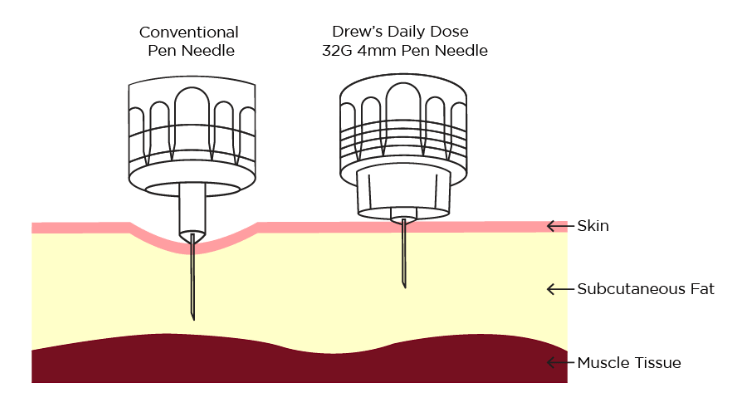
As you can see, the NovoFine Plus (Ozempic) needle (left) and Drew’s needle (middle) have a much wider base from which the needle protrudes than the BD needle (right). Based on this, Drew makes a few claims.

“Reduced Risk of Intra-Muscular Injection”. This is easier to explain with Drew’s diagram than in words.

While the needles may be the same length, the smaller width of the base allows for the skin to be pushed in more with a similar force. This, in turn, may mean the needle penetrates deeper and could hit muscle. Why is this important? Insulin disperses slowly from fat and much quicker from muscle. While generally not recommended, insulin hackers, looking to get a rapid drop in glucose levels, may choose to inject insulin into muscle, rather than fat. For the rest of us this just means less predictability and a higher risk of a hypo.

I did not notice any issue with Ozempic with either needle so I cannot say by how much the design reduces the risk but, again, if this is something you see with your current needle, this may be something to consider.

“Anti-tilt technology”. As I understand it, the idea here is that the wider base limits the pen moving around and reducing the risk of “bending and breakage”. It is true I have had a BD needle bend in site before and I have never had a Drew or NovoFine Plus needle do this. I am wondering if the anti-tilt technology also contributes to the reduced moments of pain, I mentioned earlier, when the pen moved around while the needle was in the injection site.

“Reduces Bruising and Indentation”. The claim is the reduced movement also reduces damage through needle movement, which can lead to bruising and skin distortion. I rarely bruise when injecting (I think this was more common when I first started) so this was not a differentiator for me in considering the different needle brands.

Reduces Needle-Stick Injuries

Again, this is easier to show than describe.

The idea is the green cap can be put into the back to prevent the back of the needle causing a stick injury and the bigger cap protects the front of the needle. Of the three designs, Drew’s is the only one which allows this, although it is a little fiddly. Very handy if you need to inject and you do not have a sharps container at hand.

My Overall Thoughts

The main reason I use the BD needles is because they are often available on the shelf of the chemist and it is a purchase of convenience. However, based on the above, the NovoFine Plus and Drew’s needles have superior aspects and Drew’s is the only one which is its own sharps container. While many of the claimed benefits do not speak strongly to me, this last one does, especially for travel, and for this reason, I will likely order Drew’s needles from now on as part of my NDSS pump supply orders.

If you are interested in getting the 32G*4mm needles for any of the brands mentioned, the NDSS numbers are:

  • NovoFine Plus: 165
  • Drew’s Daily Dose: 338
  • BD Ultrafine: 266