I was recently at the Annual Meeting for the European Association for the Study of Diabetes, known as “EASD”. This is the largest diabetes conference in the world (this year around 16,000 attended) and only rivalled globally by the America equivalent, the Scientific Sessions of the American Diabetes Association, the “ADA” which typically gets around 12,000 attendees.
One of the big announcements was an updated consensus guide for the management of type 1 diabetes. The previous consensus guide came out five years ago which I had merged with Buzzetti et. al.’s international consensus for the management of LADA to create an “all in one” guide for the diagnosis and treatment of someone with type 1, type 2, or LADA.
I was interested to see where LADA (“latent autoimmune diabetes in adults”) stood in the scientific consensus, given it is part of type 1, and how the guide considered its management.
What is LADA?
The 2021 version of the consensus guide did not make a strong stand on LADA saying “Controversy remains as to whether latent autoimmune diabetes of adulthood (LADA) is a discrete subtype, a milder form of type 1 diabetes, or a mixture of some individuals with type 1 diabetes and others with type 2 diabetes”. The last option came from a study where it was concluded there was enough false positive results in people with type 2 being misdiagnosed as type 1 to explain those who believe they are LADA.
Being considered a misdiagnosed type 2 (which I had been accused of on social media) was annoying and I personally discount this possibility from my own experience; I have been tested for autoantibodies on three separate occasions, all positive and yet I only needed insulin five years after diagnosis (my HbA1c had crept up to 6.8% which was, for me, too high). I am clearly autoimmune (type 1) and slow progressing and not a “false positive”.
Thankfully, the 2026 version improves on this and defines LADA as “…adults with diabetes who have islet autoantibodies but do not initially require insulin therapy.” They then give a stronger position saying “LADA represents a spectrum of type 1 diabetes, rather than a distinct subtype, characterized by slower β-cell loss than in children with type 1 diabetes and variable progression to insulin dependence.”
So, the guideline is now clear that LADA:
- Does not initially require insulin
- Part of a spectrum of type 1 diabetes which spans fast progressing (type 1 diagnosed in childhood) to slow progressing in adults (the ‘LADA’ end)
Where Does LADA Fit in?
So now LADA is considered part of the broad church of type 1 diabetes, how does it reconcile with modern models of type 1 progression?
The 2026 guide referred to the staging model of type 1 diabetes but did not have a picture showing it. The one below is sourced from detect-t1d.com
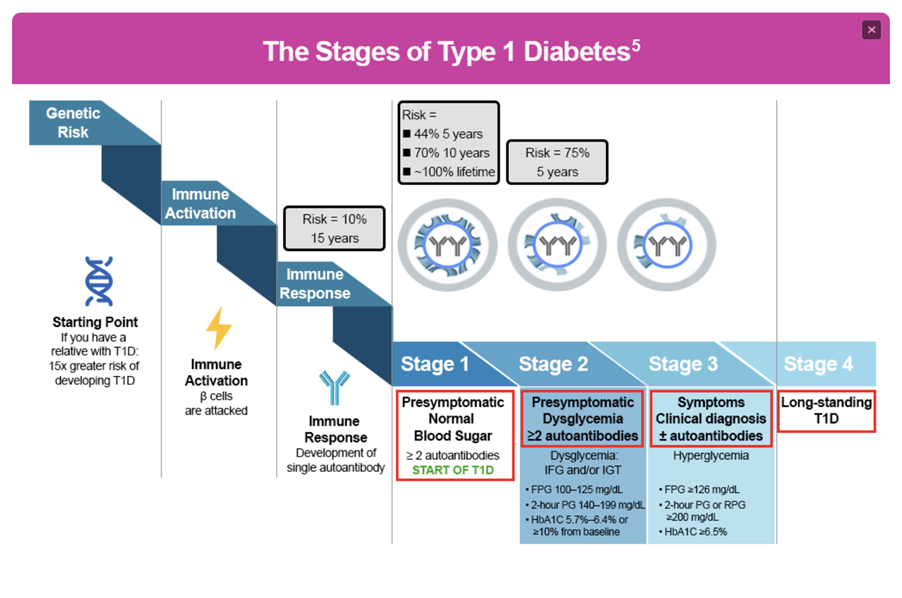
When I was diagnosed with diabetes I had three of the four T’s (Thirst, Tired, Toilet, Thinning). My HbA1c was 9.6%, and my fasting blood glucose was 259 mg/dL (14.4 mmol/L). No Thinning but the rest of the ‘T’s were there and my blood results were out of range across a wide variety of measures. While initially misdiagnosed as having type 2 diabetes, when the autoantibody tests were conducted, I was positive for the three antibodies tested (GAD, Zinc Transporter 8 Abs, IA-2). This puts me in at least Stage 2, given the ‘T’ symptoms.
From 2017 (initial diagnosis) to 2019, my HbA1c was in the normal reference range (<5.6%), managed through diet and some exercise. From 2020 to 2021 it remained below 6.5% and, as mentioned, when it hit 6.8% in 2022, I went on to insulin and it came back down again. Interestingly, my fasting blood glucose (FPG) also remained below 125 mg/dl (6.9 mmol/L) until 2022.
Based on the above data, and comparing to the figure, it seems I was in Stage 2 from 2017 through to 2021 and then progressed to Stage 3 in 2022. So, it is possible to overlay LADA onto the stage model if we acknowledge that interventions, such as diet and exercise, can put us into ‘earlier stage remission’, at least temporarily.
Guidance for Managing LADA/Slow Progressing Type 1 Diabetes/Early-Stage Type 1 Diabetes
The first guide for management in the consensus guide is the initial diagram.
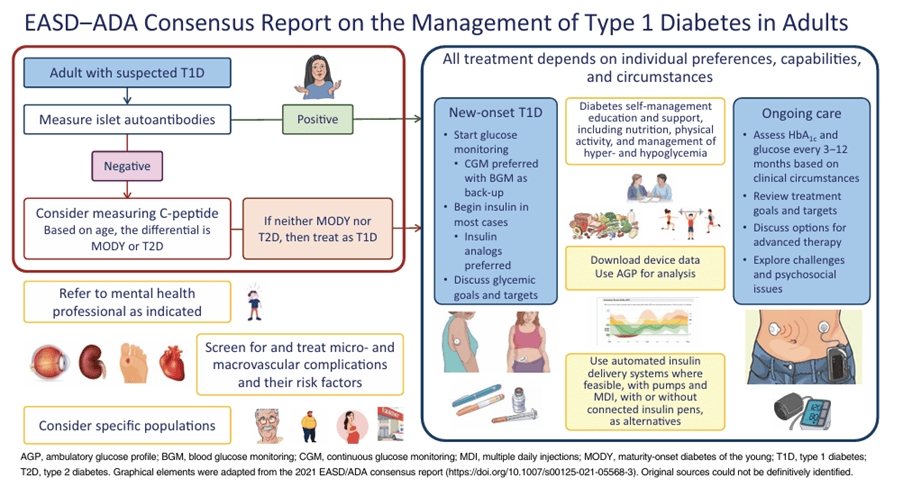
Considering an antibody-positive person with LADA, we end up at “New-onset T1D” with the recommendation of “begin insulin in most cases”, which we know, by definition, excludes LADA. The recommendation is also to assess HbA1c every 3-12 months. This is a vague cadence and, given people with LADA are not going to be on insulin, potentially dangerous because of the risk of DKA. The guide acknowledges the risk saying “Adults with new-onset type 1 diabetes are frequently misdiagnosed as having type 2 diabetes, leading to delays in insulin treatment and an increased risk of diabetic (ketoacidosis).” so it concerns me the initial figure is vague on this aspect for all except ‘classic type 1s’.
Fortunately, further into the document is a more detailed flow chart for diabetes type diagnosis.
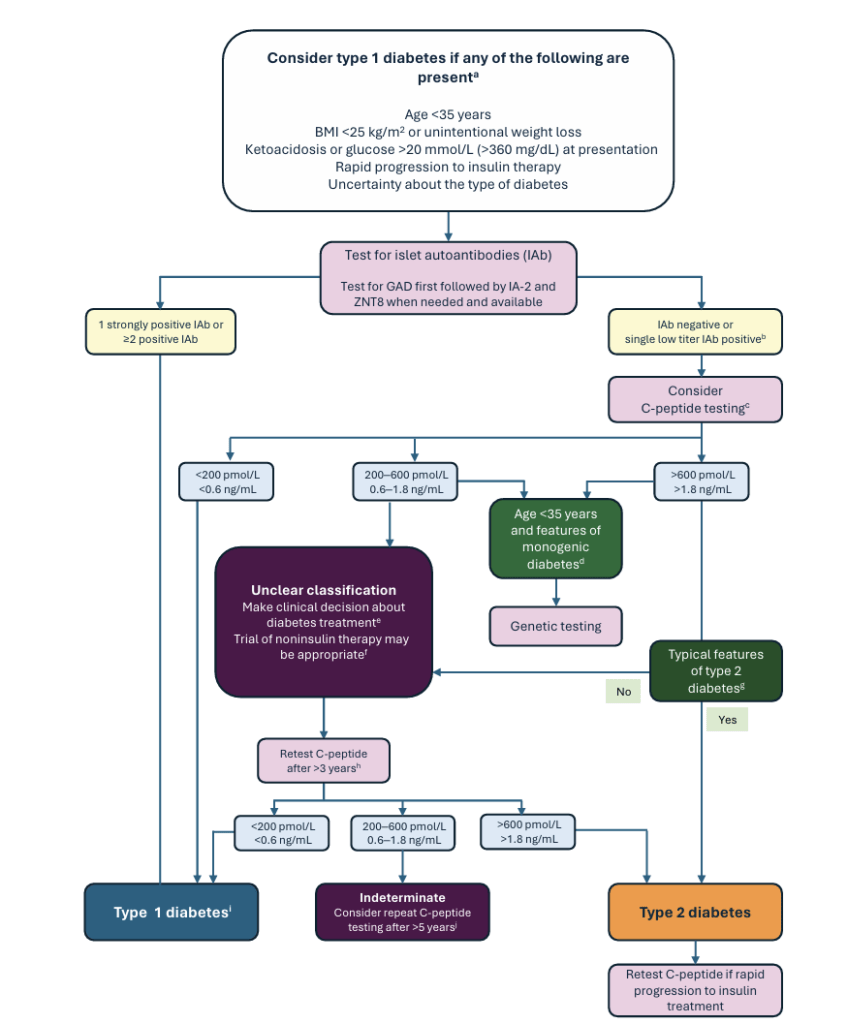
On this one, my personal version of LADA did NOT meet the initial box. I was 42 years of age at presentation, my BMI was higher than 25, while I did have ketones in my blood, I had also been fasting for more than 12 hours so the hospital decided they were ‘fasting ketones’ and not ‘DKA ketones’. Given this was the case, they chose not to do autoantibody testing and sent me away as a person with type 2 diabetes. It was my family doctor who ordered the tests a couple of weeks later, reclassifying me as having type 1 diabetes.
I contend that the initial box on this diagram may hinder accurate diagnosis of people with LADA/slow progressing type 1 diabetes, rather than help, and should be removed. However, assuming we move past the box, my autoimmunity immediately puts me into the type 1 diabetes classification.
Interestingly, the use of c-peptide as a measure for differentiating type 1 diabetes may also be problematic. In my case, up until the use of endogenous insulin, my c-peptide was in the upper end of the range or even above it (2.2 ng/mL in 2020, three years after diagnosis), presumably due to insulin resistance.
The only time my c-peptide has been below 0.6ng/mL was when I began using insulin which, of course, supressed my body’s production. A stimulated c-peptide test I did, in 2024, yielded a result of 1.71 ng/mL meaning seven years on from diagnosis I still had insulin production, contradicting (or, at least, not supporting) the guide’s claims that “C-peptide levels…are usually low or undetectable by 3 years after diagnosis.”
I mentioned earlier the vague cadence recommended for follow-up and, even though, there is an entire sub-section explaining the stages of type 1 diabetes, there are no specific recommendations for an early-stage management cadence. The stages section talks about screening to identify people at Stage 2 Type 1 diabetes but, the fact is, diagnosis of LADA/Slow Progressing Type 1 Diabetes, gives another avenue for finding people before they reach Stage 3 with none of the downsides and risks of screening. For these people, the consensus guide should provide advice on management, including measures to minimise the risks associated with transitioning to Stage 3 and a well-defined cadence for consultation/testing.
While understandable, the guide is insulin-centric in terms of its management of type 1 diabetes. With LADA/early-stage type 1 diabetes not initially requiring insulin, literally by definition, this means the guidance is not as robust as it could be for this cohort. The section on Diabetes Self-Management Education and Support (DSMES) assumes ‘Medication usage’ is exclusively insulin in its key content areas. The ‘Content areas of DSMES’ similarly speak of ‘Insulin types and administration’ but do not mention adjunct therapies.
The section on “Interventions to Manage Glucose Levels” immediately states “ Lifelong insulin therapy is essential in type 1 diabetes and should be personalized to optimize glycemic levels.” which may be true in the long-term but not true for slow progressing forms of type 1 diabetes and early-stage type 1 diabetes. We also see this in the next section on “Adjunctive Therapies for Glycemic Management” which states “…insulin therapy is essential for people with type 1 diabetes…”. It may be better to rename the guide “The Management of (Stage 3) Type 1 Diabetes in Adults…” given its focus on insulin dependence and rapid onset and with the only clear guidance for Stage 2 Type 1 Diabetes management being the use of immunomodulatory drugs such as Tepliumab.
Why Should We Care About LADA?
An argument could be made that adjusting the entire guide to account for a diabetes population which is “10% of people with type 1 which itself is roughly 10% of all people with diabetes” in unnecessary. However, it is estimated that between 6-50% of people with type 2 diabetes are, in fact, people with LADA. This makes the cohort of people with undiagnosed LADA of a size comparable to the entire diagnosed type 1 population and, therefore, worthy of consideration, especially as the guidance will also serve people identified with Stage 2 Type 1 Diabetes through screening.
How Can We Improve the Guide?
Given it was five years since the last update to the guide, it is unlikely the guide will be substantially changed in the near-term. However, we can summarise those areas for improvement with a view of including them in future releases. Specifically:
- Determine if the guide is specifically for Stage 3 Type 1 Diabetes or, more broadly, includes earlier stages and slow-progressing forms
- Assuming earlier stages are included, acknowledge that the management for type 1 diabetes in early-stage and slow-progressing forms do not necessarily involve endogenous insulin
- Give unambiguous guidance for the cadence of monitoring Stage 2 Type 1 Diabetes to minimise the risk of DKA on progression to Stage 3
- Modify the diagnosis flow chart to account for early-stage and slow progressing forms of type 1 diabetes, rather than excluding the possibility of autoimmunity. This may include elements such as genetic screening or classification models such as those of the University of Exeter.
By considering type 1 diabetes prior to Stage 3, we shift the focus from simple diagnosis of Stage 3 to progression to Stage 3, and the inclusion of management of Stage 2 and slow progressing forms. The guide becomes relevant to many more people on the journey of type 1 diabetes and the health care providers working with them.

