Thoughts on the Australian Government’s Inquiry into Diabetes

This week, on the 3rd July, 2024, the Australian government released the 23 recommendations resulting from their Inquiry into Diabetes. This blog will review each recommendation and consider its impact on people living with diabetes, and how the Australian government manages diabetes in general. The blog is quite long, so if you want the short version, head on over to the tl;dr section.

Details of the Inquiry

The Inquiry kicked off back in 24 May, 2023 when the Honorable Mark Butler MP called for a committee to investigate and report on diabetes. The Terms of Reference for the inquiry were, according to the committee’s chair, Doctor Mike Freelander, “very broad” with a view to “get as much information as we can so we can get a plan for the future”. Reading the article, the motivation for the inquiry seemed to be the incidence of obesity and type 2 diabetes in Australia and coincided with the release of a study from Deakin University confirming an increase in the rate of type 2 diabetes in Australia.

This was not an inquiry targeted at type 1 diabetes, but at diabetes in general, with obesity and risk factors also being considered. This is reflected directly in the formal Terms of Reference for the inquiry:

“The Committee will investigate:

  • The causes of diabetes (type 1, type 2 and gestational) in Australia, including risk factors such as genetics, family history, age, physical inactivity, other medical conditions and medications used;
  • New evidence-based advances in the prevention, diagnosis and management of diabetes, in Australia and internationally;
  • The broader impacts of diabetes on Australia’s health system and economy;
  • Any interrelated health issues between diabetes and obesity in Australia, including the relationship between type 2 and gestational diabetes and obesity, the causes of obesity and the evidence-base in the prevention, diagnosis and management of obesity; and
  • The effectiveness of current Australian Government policies and programs to prevent, diagnose and manage diabetes.”

The problem I have with investigating the “interrelated health issues between diabetes and obesity” and “risk factors such as genetics, family history, age, physical inactivity…” is these do not apply to all diabetes types equally, and also apply to other diseases, such as breast cancer. As can also be seen in this last link, risk factors are often conflated with causation. Correlation is not the same as causation and, in the case of diabetes, leads to a lot of unnecessary blame and stigma (there are plenty of skinny type 2s, chubby type 1s, and muggles of both sizes, so broad correlations have limited application at the level of the individual, especially when a proven chain of causality has not been established.)

As it was a public inquiry, submissions and public hearings were part of the process giving a voice, to any interest group who felt the inquiry Terms of Reference related to them, for consideration. So, from the start, there was potential for recommendations which may address broad health issues in the Australian population but not necessarily address prevention of diabetes, treatment of diabetes, or improvements for those living with diabetes. As you will see below, this lack of focus in the Terms of Reference led to a lack of focus in the Recommendations with some having tenuous links to diabetes, at best.

Let us review the recommendations and consider their implications.

The 23 Recommendations

Recommendation 1: The Committee recommends that the Australian Government undertakes a comprehensive economic analysis of the direct and indirect cost of all forms of diabetes mellitus in Australia.

This is an excellent idea. Approval for subsidised medications, equipment, and treatments rely on favourable economic consequences. Approval may require a measure of economic return e.g. spend $1 and return $2 worth of productivity within a specific time period, or an estimation of the cost for ‘Quality-Adjusted Life Years’ (QALYs.) In the case of the NDSS subsidy for CGMs, the cost came in at around $35,000 per QALY, below the unofficial approval threshold of $50,000 per QALY. Subsidies for things like Type 2 CGMs or Type 1 Loops will need to go through a similar exercise. Basically, accurate economic analysis will lower the barriers for smart decisions to be made.

Recommendation 2: The Committee recommends that the National Health and Medical Research Council expedites a review of the Australian Dietary Guidelines, and ensures that the revised guidelines include adequate information for Australians living with diabetes.

Here we see the broader terms of the inquiry coming into play. I do not see a lot coming out of this other than education programmes for ‘guides to healthy eating’. I do not believe information access is the problem. I think we all know we need to move more and eat less, preferably eating food with lower energy density. I can almost guarantee any “adequate information for Australians living with diabetes” will concentrate on type 2 diabetes and its risk factors and largely ignore any other type whose needs are different (people with type 1 are less concerned with glycaemic index/load and more concerned with total carbohydrate count, for example.) The cynic in me has no expectation this level of nuance will be captured in any revisions and expect the guidelines will not go much deeper than “fat bad, protein good, but remember to eat some carbs.”

Recommendation 3: The Committee recommends that the Australian Government implements food labelling reforms targeting added sugar to allow consumers to clearly identify the content of added sugar from front-of-pack labelling. This food labelling initiative should be separate from the information regarding added sugar potentially being included in the Nutrition Information Panel.

This one has little to do with people living with diabetes, whose concerns are carbohydrates in general, rather than just added sugar. I see this adding no value to me personally and see it causing a lot of confusion for people with type 1 diabetes. When bolusing, the need of a person using insulin is for clear carbohydrate labelling. This should not be sacrificed for ‘added sugar’ warnings.

The other concern I have is this recommendation will be seen as ‘proof’ that eating sugar causes diabetes. The causes of diabetes types 1 and 2 are unknown i.e. the reason the immune system starts attacking the pancreas in type 1 is still not understood. Even the proof that sugar causes obesity is limited so, given the Terms of Reference, I think sugar was over-represented in this inquiry.

Recommendation 4: The Committee recommends that the Australian Government implements a levy on sugar-sweetened beverages, such that the price is modelled on international best practice and the anticipated improvement of health outcomes. The levy should be graduated according to the sugar content.

Sugar levies in other countries have shown a decrease in sugar consumption and a slowing of obesity rates in children but that is all the evidence shows so far. While reductions in rates of type 2 diabetes are predicted, using the risk correlations, there has not been enough time to confirm the prediction. I am not against the idea of a sugar tax (my secret hope being it will increase the variety of sugar-free drinks on the supermarket shelves), I am simply uncertain of its place in this inquiry. The hypothesis that sugar consumption leads to weight gain which may lead to an increased rate of obesity which may lead to an increase in the rate of type 2 diabetes seems tenuous to me in its relevance for an inquiry into diabetes of all types.

Recommendation 5: The Committee recommends that the Australian Government considers regulating the marketing and advertising of unhealthy food to children, and that this regulation should:

  • Focus on children defined as those aged 16 and under
  • Be applied to television, radio, gaming and online
  • Use definition of unhealthy food that has been independently developed.

More recommendations relating to general population health with little consideration for diabetes specifically. At least Recommendation 2 threw diabetes in at the end. Again, I am not against lumping in unhealthy food in with cigarettes and alcohol, in terms of advertising, I am simply struggling to link the recommendation to diabetes and the Terms of Reference. My guess is the link is unhealthy food may lead to obesity which increases the risk of type 2 diabetes but I am surprised there were not recommendations raised with a more direct link to diabetes prevention and management. For example, Teplizumab is proven to delay stage 3 type 1 diabetes by literally years so why has it been left out of the recommendations, but an unproven sugar tax included?

Recommendation 6: The Committee recommends that the Australian Government provides its response to the Australian Food Story: Feeding the Nation and Beyond report and considers a dedicated resource within the Department of Health and Aged Care to support access to healthy food to all Australian communities.

For the curious, the referenced report can be found here. The report is focussed on food production and food security but was not about links between food and health. In fact, the word ‘health’ gets mentioned only three times throughout the report’s recommendations. Once in reference to the National Health and Medical Research Council and, of the other two references, the first calls for a National Food Council to advise the government of food matters of which ‘Health and Nutrition’ was one of ten factors to be considered. The second reference called for changes to funding research on ‘food, health and nutrition.’

As we can see, there is a theme here that food, and specifically, sugar is considered the culprit to Australia’s health issues and incidence of diabetes (diabetes type be damned). There is no doubt that access to healthy food is a good thing for Australia in general but, for me, these food recommendations miss the mark for an inquiry on diabetes of all types.

Recommendation 7: The Committee recommends that the Australian Government, in consultation and cooperation with state and territory governments, develops a best practice framework to tackle the problem of obesogenic environments, including through better urban planning and the development of physical activity initiatives and supports efforts to increase access to regular exercise in schools and neighbourhoods as a matter of urgency.

This is a recommendation exclusively considering obesity. The Term of Reference for obesity was “Any interrelated health issues between diabetes and obesity in Australia, including the relationship between type 2 and gestational diabetes and obesity, the causes of obesity and the evidence-base in the prevention, diagnosis and management of obesity.” The recommendation implies that lowering the barriers to physical exercise in urban areas will impact obesity levels. It is a reasonable hypothesis but I could not find a lot of evidence to prove it, similar to the case with sugar leading to obesity and type 2 diabetes. So, again, I question the relevance of this recommendation to this inquiry.

The recommendation is another nice idea for general health improvement but, for tackling how Australia manages diabetes? For me, it seems a poor foundation to build on. Perhaps funding research to work out the causes, rather than acting on the correlations and hoping for the best, would be a better use of money. To mix metaphors, we want to smash the causal chain, not throw stuff at the wall and see what sticks.

Recommendation 8: The Committee recommends that the Australian Government explores the potential for effective national screening programs for all forms of diabetes, particularly Type 2 diabetes.

I appreciate I have not been completely glowing in my appraisal of the recommendations so far but this one strikes me as really ill-conceived. Screening for every type of diabetes except type 2 diabetes makes more sense. For type 1, for example, we recently saw the approval for a national screening program in Italy. So why not type 2? Because there is no simple test to definitively diagnose type 2 diabetes. For type 1 we can test for auto-antibodies (which appear years before symptoms) and for MODY we can conduct genetic testing but, for type 2, the test is the symptoms i.e. elevated blood sugars and their effects on the body. There is literally no test we can conduct on a baby to determine if they are going to get type 2 diabetes and even in adults, diagnosis is a series of tests, not some simple screener.

The best we could do would be to implement regular testing of HbA1c which tells us the person may have some form of diabetes but is certainly not definitive for type 2. An elevated HbA1c, in the absence of a diagnosis of diabetes, is referred to as Pre-Diabetes and it is estimated over 1/3 of the US adult population is pre-diabetic. That is a lot of noise to filter out to find the true type 2 diabetics.

The idea of screening for MODY and type 1 diabetes makes sense to me, assuming it is cost effective (see commentary of Recommendation 1). Screening for MODY makes sense to reduce the widespread misdiagnosis and resulting mistreatment, and screening for type 1 makes sense because immune interventions can delay the onset of symptoms for years. It is clear though, screening only makes sense if something is going to be done with a positive test. Unless medical interventions are part of the overall strategy, screening is useless.

Recommendation 9: The Committee recommends that the Australian Government implements a national public health campaign to increase public awareness of the early signs of all forms of diabetes mellitus.

By the early signs for all forms of diabetes, I assume they mean the “Four T’s” which indicate an insufficient amount of insulin in the blood. Certainly, prior to diagnosis, I had enough awareness of two of the T’s (Toilet and Thirst) to know I needed to see a doctor when I was permanently thirsty and peeing every 30 minutes. Given awareness could prevent DKA death in an undiagnosed type 1, I do have some sympathy for this recommendation, assuming it is cost effective.

Recommendation 10: The Committee recommends that the Australian Government funds the development of education-based obesity screening information and resources.

More obesity recommendations which, again, speak to the health of the general population, rather than at diabetes. As with the screening in Recommendation 8, it only makes sense if there is a resulting intervention strategy for those positively identified. While ‘resources’ suggests some level of funded intervention, it is a bit nebulous.

Recommendation 11: The Committee recommends that the Australian Government implements a national public health campaign to increase awareness of the importance of prevention, identification of early signs, and good management of all forms of diabetes mellitus.

This is similar or, at least, related to Recommendation 9 regarding early signs. Prevention is an interesting one. Again, we are predicating our actions off of correlations, given the causes of diabetes in many of its forms (including type 1 and 2) are unknown. If the cause is unknown, how can we prevent it and raise awareness on what is needed to prevent it? As alluded to earlier, the usual suspects for ‘prevention’ equally apply to other diseases as they do to diabetes.

“Good management”, I assume, means eating less and moving more. I doubt this will include, for example, a national public health campaign on the correct use of insulin or on the importance of a well-rounded health care team.

What this is really recommending is a public health campaign to improve the overall health of Australians.

Recommendation 12: The Committee recommends that equitable access to health care for people living with all forms of diabetes be improved through:

  • Access to longer appointments with a health care provider subsidised by the MBS
  • Access to case conferencing models of health care, especially in rural and remote areas
  • Access to telehealth services
  • Increase in the number of item numbers for allied health consultation for those with diabetes for diabetes educators and dieticians and other allied health providers
  • Access to diabetes educators, including in high-risk outer metropolitan, rural and remote communities.

Finally! A recommendation which actually considers diabetes specifically, rather than being about general population health and issues of sugar consumption, a lack of exercise, and obesity. We are about halfway through the recommendations and, by my reckoning, maybe three of the 12 recommendations are specifically targeted at diabetes, rather than general population health.

Longer appointments are a nice idea if there is something to talk about. I would personally like to see more research and effort being put into structuring the conversations with health care providers so they are more relevant to the person with diabetes (PWD) and deliver real value, rather than being a doctor taking twice as long to tell their client they need to use insulin properly, eat ‘healthier’ carbs, lose weight, and do more exercise. How about a session where the concerns of the PWD are discussed BEFORE the blood results? How about a discussion around the various technologies available and why they may or may not be relevant/desirable to the PWD? How about a discussion of the various medications available which may be of benefit? I am hoping to construct a framework for such a discussion applying corporate motivation theory but this takes time. You can read details of my idea here.

I had to look up “case conferencing” but, from what I can tell, it is health care professional speed dating. Basically, you round up a team of health care professionals (Endo, Dietician, Exercise Physiologist etc.) and have people meet with them as part of a single session. Given the lack of health care professionals in rural areas the organised corralling of them in one spot, and the recommendation for telehealth services make a lot of sense.

Assuming it is done with cultural consideration, I see this having a huge impact in rural aboriginal communities. Aboriginal people are four times more likely to have diabetes/pre-diabetes than their non-indigenous counterparts. Anything that can be done to lower the barriers to health care and education access for these disproportionately affected communities is a good thing.

Then we move on to diabetes educators, a topic of particular interest for me. Firstly, fixing the ‘item numbers’ for allied health professionals is a great idea. A key reason why I do not see my diabetes educator is Medicare and my private health insurance do not recognise the visits. My Diabetes Educator has a Provider Number but, for whatever reason, the visits fall between the cracks. My hope would be that this recommendation would fix that.

Access to diabetes educators (DEs) is a problem in Australia whether it is in urban or rural areas although other HCPs seem to cover the shortfall so that the health of PWDs does not suffer. The online forums constantly buzz with people craving access to a DE but they either do not have one in their area or the DEs are booked out. The pathway to becoming a DE is quite narrow in that you must have a health-related qualification (dietician, nurse etc.) before you can become accredited as a DE.

My personal belief is a person who has lived with diabetes for, say, ten years, could offer tremendous value to someone newly diagnosed but the prospect of studying for three years to obtain a health degree so they can then study to be a DE is a barrier too high for many. A solution might be for a sub-accreditation for non-HCPs where PWDs can assist the newly diagnosed in a structured manner. The pool of available talent would increase and, if managed properly, would not compromise the quality of service given.

Recommendation 13: The Committee recommends that the Australian Government reviews the limits for accessing juvenile mental health and diabetes services, with a view to enabling young people to continue receiving support for longer.

I am unsure which specific programs this relates to, but it sounds like there are specific programs where the recipients ‘age out’, similar to what used to happen with the CGM subsidies when it was limited to people with type 1 diabetes who were 21 years and under. I can see this being particularly important in the case of mental health services where suddenly cutting off the services because of a birthday could be disastrous. This being said, the supply of mental health professionals, such as psychiatrists, is very limited with many having waiting lists stretching for months.

It may also be alluding to the largely useless Insulin Pump Program which subsidises insulin pumps for people with type 1 diabetes under the age of 21. To date, the program has not had a significant impact so broadening the pool of potential recipients would be good.

Recommendation 14: The Committee recommends the Australian Government work with the state and territory governments to develop education tools and resources to support all staff across the health care system to improve understanding of diabetes, its different forms, the early signs and management. The Diabetes in Schools program should be funded to allow all schools to access it.

A high-level but reasonable recommendation. In fact, the NDSS already have the National Diabetes Nursing Education Framework which would go a long way to achieving this goal. The workbook associated to the program is an outstanding resource to give this baseline understanding.

I had to look up the Diabetes in Schools program but it sounds like a great initiative.

Recommendation 15: The Committee recommends that subsidised access to Continuous Glucose Monitors (CGMs) be further expanded. In the first instance, all access limitations in relation to patients with Type 1 diabetes should be removed. Furthermore, individuals with insulin-dependent Type 3c diabetes and patients with gestational diabetes should be made eligible for subsidised CGMs and for those with Type 2 diabetes requiring regular insulin. The Committee recommends prioritising the removal of age limitations on access to subsidised access for Type 1 diabetes patients.

This is a great recommendation. Type 3c diabetes is diabetes caused by physical damage to the pancreas. This may be as a result of an accident, surgery, or perhaps cancer. People with type 3c diabetes often fall through the cracks and have a difficult time accessing subsidy programs despite often having similar needs as people with type 1 diabetes. Expanding access to people with gestational diabetes and insulin-dependent type 2 diabetes also makes sense. This may also open up the door to extending CGM subsidies to the wider type 2 diabetes cohort in the future if evidence shows it is economically viable.

Recommendation 16: The Australian Government should explore expanding subsidised access to insulin pumps for all Australians with Type 1 diabetes. A gradual increase, such as expanding access to those aged 40 and under, would be useful as an initial step.

This is another issue I have strong thoughts on, and I was a co-author on this petition which describes why the current model is broken. I was also a signatory to the recently released Consensus Statement on Automated Insulin Delivery for Type 1 Diabetes in Australia.

A gradual increase makes sense although why it would be based on being less than 40 years of age mystifies me. As far as I know, there is no medical evidence to suggest 40 years has significance in the efficacy of pump use. For me, it would make more sense to roll it out in a manner similar to how the CGM subsidy was rolled out e.g. ((type 1 diabetes AND (21 years and under OR indigenous OR concession card holder)) OR (insulin-dependent gestational diabetes). The rest of us would access a pump in the same way as we do today and, over time, the program could expend where the evidence supports the case.

Recommendation 17: The Committee recommends that the Australian Government undertakes a review of the price and choice of insulin pumps in Australia.

I have no idea where this one is coming from. We have a pretty good choice of pumps in Australia so why fix something which is not broken? I hope this is not suggesting we have too much choice and implies we should go down a path similar to, say, New Zealand where only two pumps are funded. Choice is not a luxury; it ensures people are getting the right technology to maximise their prospect of success. Their job may mean a tubeless pump is a better choice. They may have sight impairment which means a pump which connects to a phone or which has a high-contrast screen is the best option. A wider choice ensures a broader set of people’s needs can be met.

Recommendation 18: The Committee recommends that the Australian Government, subject to a positive recommendation from the Pharmaceutical Benefits Advisory Committee, expands the eligibility criteria for Glucagon-like Peptide-1 (GLP-1) receptor agonists, particularly for high-risk patients.

Yes! A great recommendation. I talked about GLP-1s and their benefits for all types of diabetes around four years ago, based on the results coming out from international conferences. These results are now filtering down to the government subsidy level and, hopefully, will soon lead to wider availability for these powerful tools although, historically, supply has been an issue.

The next generation of GLP-1s are now coming out with even more impressive results in terms of weight loss and glucose management. The most well-known is arguably Tirzepatide (Mounjaro) which is approved for people with type 2 diabetes but not type 1. Upcoming trials hope to show it is of benefit to both types of diabetes.

Recommendation 19: The Committee recommends that the Australian Government establishes mechanisms for securing supplies of Glucagon-like Peptide-1 (GLP-1) receptor agonists for disadvantaged and remote communities, including Aboriginal and Torres Strait Island communities.

As mentioned in Recommendation 18, supply of GLP-1s worldwide has been an issue. Given their benefit for both weight loss and for people with diabetes, it is a good suggestion although it is not clear to me how it is to be implemented. If those of us in the cities are struggling to get supply, and the issue is worldwide, this makes access a non-starter for remote communities whose logistics challenges will only add to the problems.

Recommendation 20: The Committee recommends that the Australian Government considers expanding access to bariatric surgery within the public system for eligible patients.

For people with type 2 diabetes and obesity, bariatric surgery has an impressive remission rate of around 50-95%. In Australia, to be eligible for the surgery you must have a Body-Mass Index (BMI) of over 40, or type 2 diabetes and a BMI of over 35. The recommendation is not clear in which direction access should be expanded (lower BMI? different types of diabetes?) Also, only so many surgeries can be conducted in Australia annually and the government would need to provide significant funding to keep up with the current demand, let alone increased demand.

Recommendation 21: The Committee recommends that the Australian Government takes steps to manage diabetes research efforts through the Australian Centre for Disease Control (CDC) by coordinating with the peak bodies such as JDRF and Diabetes Australia research priorities with an emphasis on equitable access and prevention. The Committee also recommends that the Australian Government considers increased funding for Type 1 diabetes research and clinical trials.

All sensible recommendations. I assume coordination between the relevant bodies is not as efficient as it could be and thus the call for improvement. If it means better use of money to help people with diabetes, I am all for it.

Recommendation 22: The Committee recommends that the Australian Government undertakes a survey of current diabetes-related data, with a view to developing strategies for establishing new and improving current data sources and for establishing a national diabetes mellitus register within the CDC.

This is an interesting one as I thought, until recently, that Australia had pretty good data because of the NDSS diabetes database. However, when the register was first established, ‘best guesses’ were made to the type of diabetes people had, based on the information available at the time. This summary covers the history of the NDSS register and some of the problems in the quality of its data.

To give an idea of how, even today, poor data are being captured, according to the NDSS database there are literally no people with type 1 diabetes in Australia who are insulin independent. This means LADAs who, by definition, do not require insulin for at least six months after diagnosis, are lost in the system. Why is this the case? Because it is really hard to change the details in the NDSS database once a person is registered. This means all LADAs, including myself, are told to register as insulin-dependent so that access to subsidised resources is not an issue later on. In short, there is no formal recognition of LADA in Australia and certainly no data to ascertain the prevalence and characteristics of this type 1 sub-type.

Recommendation 23: The Committee recommends that the Australian Centre for Evaluation in the Department of Treasury commits to the ongoing assessment of any actions taken in respect of Committee recommendations made in this report.

This sounds more like bookkeeping than a specific diabetes-related recommendation. Accountability is good though, so I appreciate the value of it.

tl;dr

The recommendations of the inquiry are a bit of a mixed bag, driven by overly broad Terms of Reference and, arguably, pre-conceived notions on the causes of diabetes and, specifically, type 2 diabetes.

The recommendations fall into the following categories (23 is generic and has been left off):

Sugar Recommendations (3, 4)

In short, added sugar is the devil and should be treated as such (change food labelling to call out sugar has been added and tax it). No argument from me on that front but, for type 1 diabetes, total carbohydrates is the key piece of information. As long as that is not sacrificed, all good. As for a sugar tax, if in encourages more variety in sugar-free drinks, I am all for it.

Why is sugar being mentioned in an inquiry into diabetes? No idea. Sugar is not mentioned in the Terms of Reference and its inclusion will feed misconceptions about diabetes being caused by sugar eating.

Obesity Recommendations (7, 10, 20)

The obesity recommendations (design cities for exercise, screen for obesity, and make bariatric surgery more accessible) do not talk at the links between diabetes and obesity, as outlined in the Terms of Reference and tenuously relate to “the causes of obesity and the evidence-base in the prevention, diagnosis and management of obesity”. I would argue they miss this mark given there is limited evidence that city design improves obesity rates. As for the final two recommendations, without investment in what happens after a positive screening and in bariatric services, all we are doing is creating demand for a system which is not set up to serve it.

General Health Recommendations (2, 5, 6)

In short, review dietary guidelines, regulate the advertising of unhealthy food to children, and ensure access to healthy food. All great ideas, and all as relevant to diabetes as they are to many other diseases where diet is considered a risk factor. Should they be in the recommendations for an inquiry into diabetes? Is there evidence that any of these measures will impact diabetes in the Australian population? Do they align to the specified Terms of Reference? No.

Diabetes Recommendations (1, 8, 9, 11-19, 21, 22)

The remaining two thirds of the recommendations actually relate to diabetes, which is good. Economic rigour around the cost of diabetes is a great idea (1) and provides a foundation for smart, economically responsible decisions. Screening for diabetes (I have no idea why they focus on type 2 diabetes here) and increasing overall awareness to enable ‘self-screening’ (8, 9, 11) makes a lot of sense. Catching diabetes early in all of its forms improves outcomes for the individual and the country.

Improved access to health care professionals (12, 13) for all Australians is a good idea but the shortage of these professionals is not considered in the recommendations and risks straining an already strained system further.

The call for improved education of health care professionals in their knowledge of diabetes (14) is a great idea. Many people with diabetes (especially people with type 1 diabetes) actively avoid engaging with the health system because they know they will need to educate the HCP themselves and, often, their knowledge and experience will not be respected and ignored for a lecture received back in medical school decades earlier. Improved education is a tide which will raise all boats and improve the system for all.

Improved and subsidised access to proven medications and technologies (15, 16, 18, 19) is a great idea although I am concerned about the suggestion to review the choice of pumps (17) unless this is aimed at getting the most recent pumps into the country as Australia is a version behind in many CGM and pump systems. The suggestion to use a cut-off of 40 years of age for pump subsidy confounds me and is misaligned to previous Australian subsidy schemes and pump subsidy schemes being rolled out internationally.

Improved research funding administration and access to data (21, 22), as with Recommendation 1, will only improve the decisions made in the future. We can only set our direction when we know where we are, where we are wanting to get to and the means we have to get there, and while many of the recommendations make good guesses to the direction we should head, Recommendations 1, 21, and 22 enable a foundation for much smarter navigation.

Conclusions

There are some good ideas here but there are also missed opportunities and half-solutions. Screening for different diabetes types and for obesity is well and good but what then? The emergence of immune intervention treatments for type 1 diabetes e.g. Teplizumab is also a missed opportunity and a great solution to the question of screening next steps. The lack of health care professionals to service the diabetes community is also absent from the recommendations despite calls to increase demand.

I look forward to seeing how these recommendations are implemented and hope, the ones which are truly focussed on diabetes get the attention they deserve. Diabetes is a costly disease for both the individual and the country so smart, evidence-based decisions, will make a big difference.

Getting Medical Interventions Approved By Government

Having played for a few years at the nexus of academia, big pharma, and government, it is interesting to watch how these three bodies orbit each other and interact (for those of you familiar with the Three-Body Problem you know such a system is often unstable, but I digress). It is often frustrating, being a person with type 1 diabetes, knowing there are, for example, medications out there with overwhelming evidence behind them but which are not funded by government national health programs. GLP-1s are a great example. These are well established to provide benefit to people with type 1 diabetes but are still, certainly in Australia, not covered and financially out of reach for those who would benefit.

So, what does it take to get something approved for government subsidy? I see four major factors which are necessary, and I thought I would write this article to describe them. For context, I will use the subsidy of continuous glucose monitors (CGMs) for people with type 1 diabetes (T1Ds) in Australia as a case example.

The ‘Ask’

The first step is a clearly articulated ask: “We would like the government to fund/subsidise <x>”. In the case of CGMs for T1Ds, the ask is “We would like the government to fund/subsidise CGMs for T1Ds”. In reality, the ask for was for a specific subset, and the program was expanded to all T1Ds over time (for reasons explained later), but I will keep things simple to illustrate the point.

It is, at this stage, where we can answer why GLP-1s are not available for T1Ds in Australia. The fact is, in the case of Ozempic, Novo Nordisk has not asked because they have no need to. Demand is outstripping supply such that Novo can set the price as they wish and run their factories at full speed. Asking will create a new audience which they cannot serve and force a negotiation on price. There is no motivation to do this until general demand abates or supply can be scaled up.

The Medical Benefit

The ‘Ask’ needs to be justified by a tangible benefit which can encompass quality of life measures and overall health measures. In the case of CGMs for T1D, subsidy would allow more people to access the technology and significantly reduce the need for finger pricking. Near-real-time tracking of glucose levels would reduce the risk of serious hypoglycaemia and hospitalisation. All good things and a great improvement for the lives of people living with type 1 diabetes.

The Medical Benefit provides the “So What?” element to the request and can be very emotive. A piece of wisdom often used in sales is people make decisions on how they feel about the purchase and justify it with logic after the fact. The Medical Benefit is the door to stirring the heart of government to act and, in turn, makes for an emotive tale for voters for justify the spend and show the government cares.

The Evidence

A good tale still needs evidence. Aristotle’s ‘Art of Rhetoric’ speaks of three key elements necessary to persuade:

  • Ethos: The argument should be from a credible body
  • Pathos: The argument should stir the emotions of the receiver
  • Logos: The argument should be based in reason

I have taken it as given that, if a request is being made, for it to get the ear of the government, it will need to be from a credible source (Ethos). The Medical Benefit is the key to providing Pathos and clinical/world evidence is the key to Logos. Without evidence, it is a stirring tale but an unjustified one. A government needs to back decisions on reason otherwise the opposition will exploit the weakness.

In the case of CGMs for T1Ds, there was a wealth of clinical evidence showing improved health outcomes with the use of CGMs. I gave an example of this back in 2021 in the context of PWD pregnancy and the use of CGMs.

The Economic Benefit

Governments are required to be fiscally responsible because of scarce resources. In short, if the government is to spend a dollar, it needs to do so on whatever yields the most benefit. For medical interventions, economic justification is usually measured in cost per QALY (Quality-Adjusted Life Years). Basically, a threshold needs to be met where the cost generates a minimum level of benefit which, in this case is a longer and better quality of life for the individual.

The threshold varies from country to country and, while there is no official limit in Australia, a general rule of thumb is government will consider a medical intervention which costs less than $50,000 per quality adjusted life year.

In the case of CGMs for T1D, the economic numbers came out at around $30-35k per QALY and the request was approved.

Case Example: Automatic Insulin Delivery for T1Ds

Let us consider a couple of items being discussed in the diabetes community at this time. The first is equitable access to insulin pumps and, by extension, looping (Automatic Insulin Delivery aka AID) for all Australians. In Australia, while CGMs are subsidised by the government for T1Ds, pumps are not and need to either be purchased directly or obtained through private health insurance. Given a pump costs literally thousands of dollars this puts it out of the reach of many Australians and I recently helped co-author a petition to help get this changed which I encourage you to sign (QR code below).

So, based on the four elements mentioned above, how would we expect the request to fare if raised by a credible body to government as part of, say, the Inquiry Into Diabetes?

The ‘Ask’: This is relatively straightforward i.e. “AID systems should be subsidized for T1Ds”

The Benefit: Lots of qualitative and quantitative benefits to AID systems such as better overnight control, improved HbA1c and Time in Range, and less manual intervention by the T1D.

The Evidence: Lots of clinical and real-world evidence to support this from companies such as Medtronic.

The Economic Benefit: While it would be great to subsidise AID systems for all T1Ds, to get the appropriate cost per QALY, it may be necessary to pick a sub-group e.g. children (who consistently have higher HbA1cs than their older counterparts in trials), T1Ds who are pregnant and so on. Generally, the cohort selection will be driven by The Evidence as this informs the economic modelling. In other words, if there are no studies of AID systems helping pregnant T1Ds, it will be harder to economically justify their inclusion.

Case Example: CGMs for People with Type 2 Diabetes (T2Ds)

On the back of the benefits seen in T1Ds with the use of CGMs it makes sense to expand the program to T2Ds.

The ‘Ask’: Again, this is relatively straightforward: “CGMs should be subsidised for T2Ds”

The Benefit: T2Ds being able to see how food affects them will inform eating habits and improve health outcomes.

The Evidence: There is some evidence of benefit for insulin dependent T2Ds but the body of evidence for general benefit is still being gathered with limited long-term studies to justify The ‘Ask’. To quote this last paper, literally written this year, “…few studies reported on important clinical outcomes, such as adverse events, emergency department use, or hospitalization. Longer term studies are needed to determine if the short-term improvements in glucose control leads to improvements in clinically important outcomes”

The Economic Benefit: Without evidence to act as a foundation for the modelling, it is harder (not impossible) to determine a cost per QALY. The best hope would be to exclusively focus on where there is evidence (insulin-dependent T2Ds) with the hope that, as more evidence is acquired, the program can be expanded to the wider T2D population.

Conclusions

It is easy for us to be frustrated with the glacial movement of governments to get behind the latest advances in technology and medicine when it is clear, for those of us at the coalface, there are benefits to many, many people. However, as we can see, with competing priorities, it is important government spending is used as effectively as possible.

The inclusion of medical interventions in national health programs requires collaboration of all three bodies (big pharma to provide the intervention, academia to show it works, and government to provide the funding) and the will by all of them to drive it. Without this willingness and the elements mentioned above it is hard, if not impossible, to achieve success.

The 12 Levers You Can Pull To Manage Diabetes

My perspective on managing diabetes is it requires a multi-faceted approach. I refer to the strategic elements of this approach as ‘levers’. The way I see it, it is a case of working out how hard you can personally pull each lever and which ones work for you.

What are your Goals?

Before a strategy can be put in place, we must have an idea of where we are heading, what are our goals? These can be big, hairy audacious goals (I want completely normal blood sugars) or smaller ones (I want to reduce my HbA1c). With goals in mind, we can start to use the levers to get us there.

My goals are:

  • Minimise daily management to avoid burnout
  • Reduce my HbA1c to a point where my risk of long-term complications is no more than 2x baseline

That’s it! Goals do not need to be complicated and, in my case, one is qualitative (minimise management) and the other quantitative (based on my previous blog, getting an HbA1c under 7.0% is good, getting under 6.4% without hypos is better).

What External Factors Can Hinder Us?

In moving towards our goals, there are factors which may impede our progress. T1D Mum provided this great summary of “social determinants of health” which impact our lives.

While ‘Individual Lifestyle Factors’ speaks directly at the levers I am referring to, as we more further out, our ability to influence the impact on our lives becomes harder e.g. ‘Water and Sanitation’ without significant upheaval to our lives e.g. changing one’s job/home/country or, as t1d mum suggested through advocacy and demand for change. Perhaps we should include advocacy as a lever to address this although it is a slow moving one.

Levers You Can Pull

I brainstormed as many levers as I could think of and went to social media to see what other levels people could come up with.

These are the ones the collective came up with in no specific order:

Let us go through them.

Food

Arguably the lever which gets talked about the most and possibly one of the easiest to pull in some fashion. Clearly, reducing the amount of fast-acting carbohydrates will help with blood sugar spikes but, after this, we may adopt a different approach, based on our goals, beliefs, and social context.

For some, a ‘carnivore’ approach is the way to go given muscle tissue has many of the nutrients our body requires with zero carbohydrates. For others, a plant-based diet which reduces insulin resistance makes more sense.

Given how tightly food in woven into human culture, it is hard to give hard and fast rules about how to pull the food lever which will apply universally. Everyone will have an idea of the changes they can practically make to their diet to steer them towards their goals.

Sleep

The CDC gives a great summary of the benefits of sleep for people with diabetes. The very short version is a good night’s sleep is a relatively simple lever to pull to help you towards your goals. Tim Street correctly points out though that adjusting sleep patterns can have unpredictable effects to basal rates and glucose levels (Dawn Phenomenon) so make changes slowly.

Exercise

It is news to no one that exercise is beneficial to health in general and diabetes specifically. Again, I will pull out Dr. Dessi Zaharieva’s exercise slide to summarize the benefits.

Medication

Gone are the days when the only medication for diabetes was insulin. We now have drugs which reduce insulin resistance (Metformin), actively remove glucose from the blood (SGLT2is), and restore the satiety response (GLP1s) as well as many others and many more coming.

It may not be a lever any of us relish pulling but it is there for us to use as we see fit.

Technology

Even in the seven years since my diagnosis, technology has progressed significantly and continues to do so. We now have commercial looping systems which act as an artificial pancreas and, while not perfect, they can provide tremendous benefit in managing, for example, overnight levels.

Health Care Team

A good health care team is vital for good management. They act as a source of expertise as well as a sounding board for your own thoughts and discoveries. The ability to engage with the health care team or adjust its composition varies greatly from, for example, rural to urban areas which can limit how much this lever can be pulled and how effective it is.

Social Media, Online Resources, and Peer Support

Another resource for information and ideas, social media, online resources and peer support, like the health care team should be carefully curated so they work for you, rather than against you. Unlike the health care team, a lot of what is found online is unregulated so, even more than the health care team, critical thinking is needed to work out what is useful, what is unfounded, and what the agenda is behind the information. For example, I trust PubMed much more than medical ‘evidence’ from Twitter or Facebook. However, in terms of looping and success in managing LADA, online discussion groups have been essential. As Tim Street puts it “Peer Support…opens minds to methods that may help…”

Family, Friends, and Allies

Online support is one lever but support in the real world is another we can pull. As Tomorrow’s Gone suggests, having family and friends who are ‘followers’ to CGM data, who can help out on sick days, tell you when dinner is going to be ready so meals can be effectively managed, or do supply-runs when they unexpectedly run out is a great asset to have. Tomorrow’s Gone also mentions making allies of others such as the school a person with type 1 diabetes attends by providing a care plan.

Financial Status

There is flexibility in money and, therefore, financial status can greatly impact our success in managing diabetes. It is also one of the hardest levers to pull given the inherent expense in managing diabetes and the financial commitments of everyday life e.g. we may want to use certain technologies or medications but cannot afford them. Therefore, getting financial advice and stabilising finances with a budget can be a great lever to pull.

Time

As we can plan our finances, so too we can plan our time and give ourselves flexibility to explore other levers such as exercise or sleep. While none of us want to be a slave to a strict time regime, some planning and organisation can provide benefit.

Stress/Wellbeing/Mental Health

Stress hormones can cause havoc with blood glucose levels and maintaining good mental health is vital to keep the diabetes gremlin in its cage. Whether it is doing something relaxing such as meditation or yoga, or regularly seeing a mental health professional, there are ways we can keep our mind clear to tackle the demands of the body.

Education

This arguably overlaps with some of the other levers such as having an effective health care team and making good use of online resources but, as it also covers physical media such as books or university courses, I have called it out as a distinct lever.

Also, you are your best advocate in managing this disease. You know your body better than anyone and have the greatest motivation to keep you healthy. Arguably, this can only be done if you are educated about your body, about diabetes, and about the levers you intend to pull.

Education regarding your own body is an interesting one because this knowledge can only come from self-experimentation and not from the internet, a book, or a university. Dave Dikeman mentions practical knowledge of insulin dosing as an example which is vital if manually injecting and can be quite individual, depending on insulin resistance and diet.

Education can come from a variety of sources, such as those mentioned, and, for me, empowers and amplifies many of the other levers available.

No Lever Acts in Isolation and Levers can be Inconsistent

As you read through it may have occurred to you that some levers affect others, as mentioned with education. Also, levers may not always act the same way. For example, with a women’s monthly cycle insulin resistance can significantly change, affecting the way insulin, food, and exercise impact the body.

For this reason, I believe there is not one lever which is more important than any other and over-reliance on any one lever can set us up for failure. For example, an over-reliance on technology means we may be in big trouble if it fails. Using diet, being educated on how to inject safely as a backup, and having a robust support network means we have contingencies if technology fails. As Steve Norris sums it up “I think the problem is that the levers don’t pull consistently, nor do they act in isolation. A holistic, yet unburdened, approach is important…”

My Poster for ATTD 2022

Being part of the dedoc voices (https://dedoc.org/voices); a group of online advocates for people with diabetes who attend diabetes conferences and pass on what they learn to their respective communities gave me the opportunity recently to attend ATTD 2022, one of the largest and most prestigious conferences in the diabetes research calendar.

I had attended virtually last year and this had the unintended consequence of being added to the conference mailing list. While most emails advertised presentation by conference sponsors, about a year after attending, I received a “call for papers for ATTD 2022”. While not an academic in the field, I wondered if the subject matter of one of my blogs would make for appropriate content at the conference. So I submitted my blogs (here and here) on merging the reconciliation reports for Type 1 and LADA. To my shock and delight, it was accepted as a poster for the event.

Once dedoc discovered my submission had been accepted they also offered to fly me to the conference in Barcelona, Spain to promote my poster at the conference as I was the first dedoc voice who had a poster accepted for the event. Not only would I be participating in the conference, but I would also be there in person, rubbing shoulders with the greatest minds in diabetes research. It was very exciting. I set about putting my poster together which was simpler than I thought. I literally used Microsoft Visio to create the flow diagrams of my poster and Microsoft PowerPoint for the poster itself. It could not have been easier. With the generous help of others in the dedoc community with experience at submitting and reviewing academic medical posters, I put together something worthy of the conference.

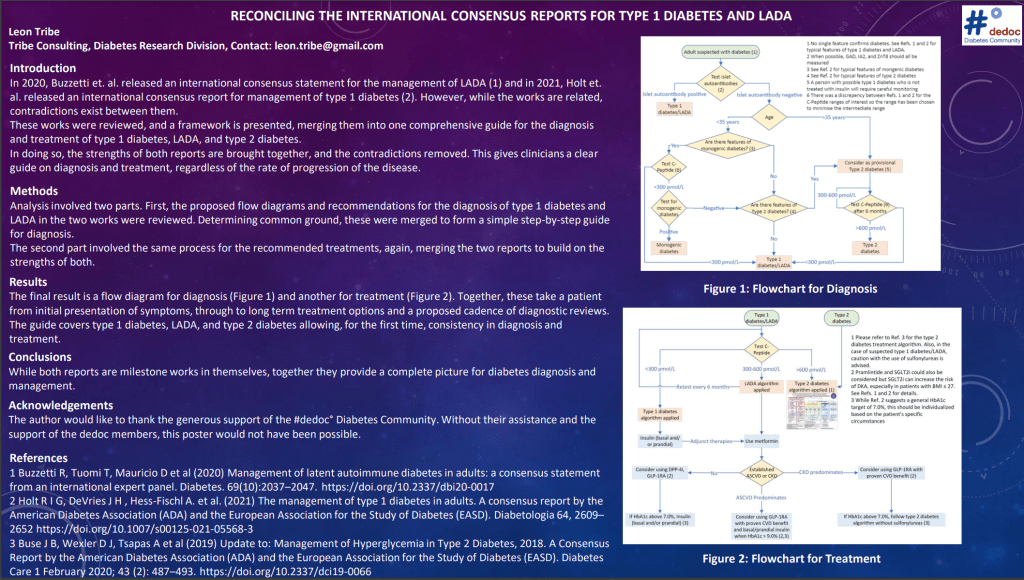
The idea behind the poster was simple. In 2020, an international expert panel released a consensus report for the diagnosis and treatment of LADA (Latent Autoimmune Diabetes in Adults), also known as Type 1.5. A year later, the American Diabetes Association (ADA) and the European Association for the Study of Diabetes (EASD) released a consensus report for the diagnosis and treatment of Type 1 diabetes. Given LADA is often considered a sub-type of Type 1 it is reasonable to expect the two reports to have consensus with each other, but they did not.

The poster sought to reconcile the two reports and, in doing so provided a flowchart for the diagnosis of diabetes across multiple types of diabetes.

Starting with someone showing classic symptoms of uncontrolled diabetes (thirsty, rapid weight loss, tired, frequent urination) the patient is first testing for auto-antibodies. A positive test immediately confirming Type 1/LADA. If negative, the age of the patient is considered. If they are less than 35 years old, and show signs of monogenic diabetes (MODY) such as a parent with diabetes and a relatively low HbA1c, combined with a medium to high c-peptide level, then genetic testing should be used to confirm or rule out monogenic diabetes. Next, we consider if there are typical Type 2 features such as an increased Body Mass Index. If so, we consider it as ‘provisional’ Type 2 and monitor the c-peptide levels every 6 months. If the c-peptide levels remain above 600pmol/L we consider them Type 2. If the levels drop below 300pmol/L, or there are not features of Type 2 diabetes, we assume it is Type 1/LADA without the presence of auto-antibodies.

For the first time, we have a diagnosis flow diagram for diabetes starting with a patient with symptoms, but an unspecified type, and we move through a series of tests to arrive at a diagnosis of MODY, Type 1/LADA, or Type 2 diabetes. For patients where it is still unclear whether it is Type 1/LADA without auto-antibodies or Type 2 diabetes, we have a clear cadence of checks until the right diagnosis is revealed.

From there, the reconciliation of the consensus reports led to a second flowchart for the treatment of Type 1/LADA and Type 2 diabetes. For Type 2 diabetes, the treatment is as specified in the consensus report for the management of Type 2 (also released in 2020). For Type 1/LADA, the results of the c-peptide 6-monthly checks inform the treatment. If the c-peptide levels are greater than 600pmol/L then the treatment follows the Type 2 protocol, with the recommended exclusion of sulfonylureas. If the c-peptide levels are 300-600pmol/L then the ‘LADA protocol’ is used which recommends the use of metformin with other adjunct therapies, depending on the presence of cardiovascular or chronic kidney disease. These adjunct therapies include DPP-4 inhibitors, GLP-1 receptor agonists and, if the HbA1c is sufficiently high, insulin (basal and/or prandial). If the c-peptide levels are less than 300pmol/L, the ‘Type 1 protocol’ is used which is effectively identical to the LADA protocol but specifies the immediate use of insulin (basal and/or prandial).

In the case of the second flow diagram, we have the basis for a well-defined protocol of treatment for Type 1, LADA, and Type 2 diabetes with treatment modifying as the disease progresses, in the case of LADA diabetes. Moreover, as new diabetes treatments are developed, they can be incorporated into the protocols, based on the evidence for their efficacy.

The importance of the poster is this is the first time we have a set of protocols that any health care provider can follow for the diagnosis and treatment of diabetes, backed by the international consensus of leading authorities. In my opinion these flow charts should be on the wall of the office of every health care professional who treats people with diabetes. While there is still the potential for misdiagnosis and mistreatment, by adopting a common standard, the flowcharts can be constantly improved to maximise the quality of care for people with diabetes.

Overall, I have really enjoyed the experience of putting the poster together and taking it to an international diabetes conference. The next steps are to collaborate with diabetes academics to write a peer reviewed paper on the subject. This will also provide the opportunity to update the recommendations with the latest conclusions from the literature in terms of medications but also in terms of devices such as continuous glucose monitors, pumps and looping technology.

What I have learned from the experience is this poster is proof that the voices of the diabetes community are important and can make a difference, not only in their own communities but on the international stage. We are worthy of participating in all arenas because no one knows diabetes as well as a person living with it. We are all experts of this disease in our own way and our experience and wisdom is important. If you have an idea or potential discovery which can help people with diabetes, do not be held back by doubt but pursue it. I promise you will not regret it.

Insulin Cooling Battles: Breast Pads vs Breezy Packs

This is part of an on-going series where I compare different technologies available for keeping insulin cool so it does not spoil.

Previous battles were:

In this battle I compare Breezy Packs to breast pads.

Why Breast Pads?

It may seem like a curious choice but there is method to it. In “Frio vs Breezy Packs” I mentioned that Breezy Packs use Phase Change Materials (PCMs) to maintain the internal temperature. For a rundown of the physics on how they work, head over to that post.

While the specific material used in Breezy Packs is a trade secret, one candidate substance is octadecane whose melting point is around 28C (82.5F). While not listed on the box, on eBay the listing for the breast pads had octadecane as one of the main ingredients. For $20 it was worth a shot.

Sure enough, on touching the pad there was a cooling sensation so things were promising.

The Setup

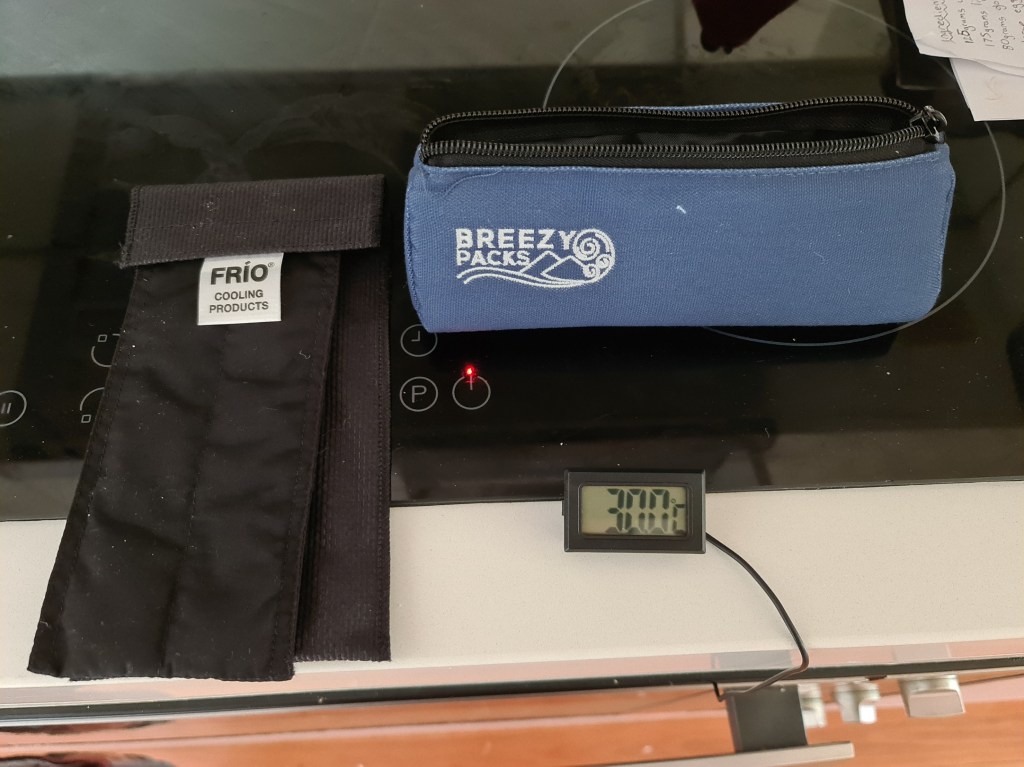
For Breezy Packs, I used their smallest size and put one of my Ozempic pens inside with a digital temperature sensor embedded within it.

For the breast pads, I used a mesh pencil case I had picked up and layered the breast pads inside with another pen with a sensor between them.

In the image you only see the pads on one side but I did put eight on one side and eight on the other for the experiment.

A third sensor was used to track the oven temperature.

With the two containers on a rack on an oven tray (I did not want the tray to be in direct contact with the containers) I placed them in the oven and took the temperature around every five minutes until one of the containers went past 30C (86F).

Prior to entering the oven, the breast pads consistently measured a lower temperature than the Breezy Pack. I assume this was because of the higher area of contact between the pads and the insulin pen. However, things changed when the oven became involved.

The Results

While the breast pads initially showed a lower temperature, this soon changed. Both were pretty stable but, at 17:15, the temperature of the oven was continuing to fall and was heading towards 30C so I increased the dial by a small amount. The different response can be seen with the breast pads increasing temperature much faster than the Breezy Pack and eventually hitting 30C. In fact, over 40 minutes, the breast pad temperature went up by 7C (12F) compared to 2C (3F) for the Breezy Pack.

Conclusions

Breezy Packs wins again although I suspect if we used a similar volume/weight of breast pad PCM the result may have been different. This being said, the amount of breast pads needed to achieve this would be excessively expensive. As with previous experiments, the components were fully funded by myself without commercial sponsorship of any kind.

Insulin Cooling Battles: Frio vs Breezy Packs

My previous battle, Frio vs Gel, showed that while a gel pack slows down the transfer of heat, it has no power to stop that heat energy eventually reaching the contents of the pouch. In contrast, the evaporation of the water from the Frio pouch actively fights the heating of insulin by redirecting the heat energy to converting the water from a liquid to a gas.

In this battle, we have two related, but different technologies which both redirect the heat energy to perform other tasks than heating the pouch contents. As mentioned, for the Frio pouch, it is the conversion of water to steam and, for the Breezy Pack, it is the melting of a mysterious substance called a PCM (Phase Change Material).

What are PCMs?

We know from high school science that, in the everyday world, matter is in one of three states: solid, liquid, or gas. What we may not know is, to move from solid to liquid, or liquid to gas takes energy. The scientific term for the energy required to melt a substance is the “Heat of Fusion” or “Enthalpy of Fusion” and it is measured in energy per weight e.g. kJ/kg or energy per volume e.g. MJ/m^3.

The energy needed to evaporate a substance is called the “Heat of Vaporization”. It turns out the energy needed to evaporate water is really high. It literally takes five times the energy to get water to turn to steam once it reaches boiling temperature than it takes to take water from ice to that temperature. So, if you have a kettle or heater which can get your water to just under boiling temperature, and that serves your purposes, do so because you will save a LOT of money on energy bills.

So, in the case of our Frio pouch, the PCM at play is water going from a liquid to a gas. While water does boil at 100C (212F), even at 30-40C (86-104F) we get some cooling effect because the water molecules in the Frio pouch are at a range of energy levels so a little heat energy can tip some of these over to becoming a gas at these lower temperatures. This is why we may see a little steam, even before the water is boiling.

In the case of Breezy Packs, the makers do not reveal what the PCM substance is but we can make an educated guess.

What is the PCM in Breezy Packs?

This is what we know:

  • The substance is solid below 25C (77F) and turns to a liquid above this temperature. We know this from the instruction sheet.
  • From the Breezy Pack website, the substance begins to melt above 27C (80.6F)

Going to Wikipedia, we have a range of common PCMs. Assuming the manufacturers have gone for an inexpensive PCM whose melting point is somewhere above room temperature and below the fail temperature for insulin (around 30C/86F) the obvious choice is Sodium Sulfate, maybe with some salt added. At US5c/kg, it is the cheapest PCM in the table, after water. You will notice below that pure Sodium Sulfate melts at 32.4C (90.3F) but, adding a little salt brings this down to a lower temperature. I have bought some pure Sodium Sulfate to experiment with and see if I can replicate the Breezy Pack but that is for another post.

The Experiment

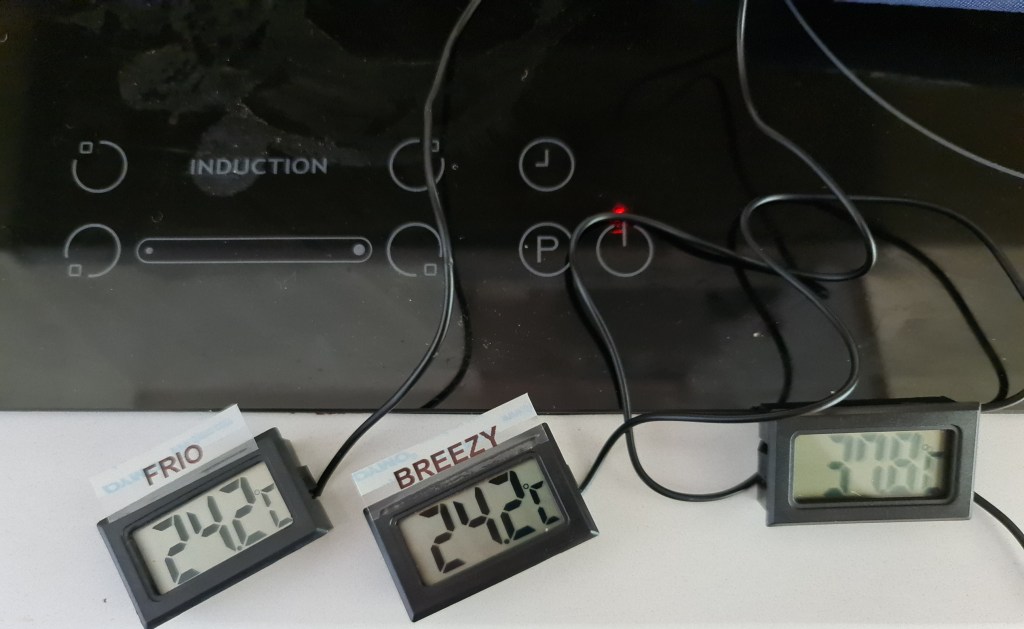
As with the Frio vs Gel experiment, I have enlisted the help of my oven to maintain an even temperature. While I used the middle shelf and the fan forced setting last time, I was finding the oven was going above 46C (115F) which I did not want so I put the Frio and Breezy pouches on the lower shelf with only the top element on. I also put a dishcloth on the middle shelf to act as a shield from the direct heat of the heating element. I also put the two pouches on two plastic cutting sheets to prevent contact with the metal bottom.

The wires were linked to digital sensors so I could monitor the temperature.

The blank one is the temperature of the oven.

The Breezy Packs, at the time of writing come in two versions: Breezy Basic and Breezy Plus. Both of these are the same physical size but the Breezy Plus contains more PCM so it can work for longer. This experiment used a Breezy Basic. The Frio pouch was the same one as I used in the Gel comparison and was soaked in water for the same amount of time prior to going into the oven i.e. 5 minutes. The only difference was the temperature of the water used which, in this case, was room temperature and not, as last time, from the cold tap.

The Results

So, for an oven where we the temperature is between 35-40C (95-104F), we see that the Frio took around 15 minutes to go from 25C (77F) to 30C (86F). In contrast, the Breezy Packs only moved 1.5 degrees Celsius over the same time period.

The rapid rise in the Frio surprised me as it took twice as long to move the temperature the same distance but, even if we use the Frio vs Gel pack results for considering the Frio pouch, we see that it is still out-performed by the Breezy Pack. My guess is the sensor in the Frio pouch was closer to the outside this time around and, therefore heated up quicker. An alternative explanation could be the difference in oven temperature from last time changing the performance of the Frio pouch i.e. the oven ran a little hotter, although more consistently this time around than last time.

Conclusions

To my initial surprise, the Breezy Pack strongly outperformed the Frio pouch. In hindsight, this makes sense. If we think about it considering the PCM in each case, for water, most of the water molecules are still too cold to transition to a gas state and, therefore the heat energy is simply used to warm the material. For the Breezy Pack though, the majority of the molecules are close to melting and will more heat energy can be redirected away from heating the pouch.

Given the Breezy Pack requires no soaking, is not damp and simply works and given the price point for both the Frio pouch and Breezy Pack are similar, it seems clear the Breezy Pack is the superior option between the two when carrying a couple of pens.

Please note: I bought all pouches with my own money and have received no financial benefit in this comparison. This being said, I am very, very open to receiving sample pouches if either Frio or Breezy Pack want me to compare different sized models in the future 😉

Insulin Cooling Battles: Frio vs Gel

David Burren recently put me on to Breezy Packs which, if their claims are to be believed, offer a new way to keep insulin cool in the field. I have ordered a couple of Breezy Packs to put them through their paces but, first, I thought I would try out the existing methods commonly employed to show how they work.

Gel

Gel packs contain gel (no surprise there) which holds its temperature well and acts as an insulator. There is no actual cooling mechanism here other than the gel slows heat passing from one side to the other. So, to use a gel pack, you cool it down in the fridge (not the freezer as insulin does not like to be frozen) and put your insulin inside it to protect it from outside fluctuations in temperature. Outside heat is slow to heat up the gel pack which means the insulin stays cold.

Frio

Frio is, arguably, the most popular brand name for evaporative cooling pouches for keeping insulin cool. There are other brands out there (I even sell a version in my Etsy store) so feel free to shop around. They all work in the same way though. You immerse the pouch in water for, say, five minutes and it puffs up. You take it out of the water, wipe it down and put your insulin inside.

Not only are the pouch contents (generally silica gel beads or similar) an insulator but they are spectacular at absorbing and holding on to water. How Frio bags work is, when exposed to a warm temperature, the water in the beads begins to evaporate but evaporating water molecules takes energy so, instead of the external heat being used to raise the temperature of the water, some of it is used to turn the water to steam. This means the water temperature stays reasonably stable and, in turn, so does the temperature of the insulin inside the pouch. Our bodies use the same trick to stay cool when we sweat.

Breezy Packs

Breezy Packs offer a new way to keep insulin cool, which is similar to Frio bags but, instead of absorbing energy, turning water from liquid to a gas, it converts its active material from a solid to a liquid. No need to soak and wipe down. The physics of Breezy Packs is actually very smart so I will save it for when the pouches arrive and I will write another blog on the subject.

The Cooling Battleground: My Oven

It turns out that I can get my fan-forced oven down to around 30-40 degrees Celsius (104 degrees Fahrenheit) so this was my “controlled environment”. The contestants were a small Frio pouch capable of holding two insulin pens and a massive pillow gel insert.

The insert is 30x40cm with three panels. Both pouches went onto an oven tray with baking paper underneath to try and insulate from the metal bottom.

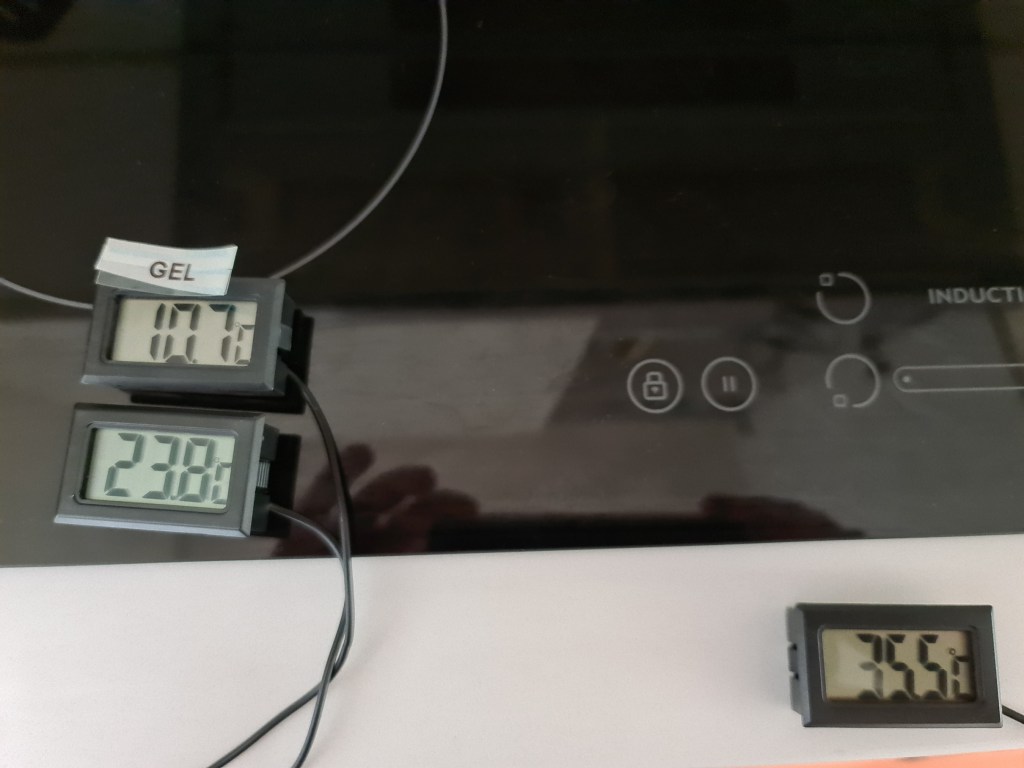
The gel pad was folded into three with two of the panels at the bottom and both pouches had a temperature probe put in the middle of them. As indicated above, the gel pad had been stored in the fridge whereas the Frio was soaked in tap water.

Once in the oven, I monitored their temperature and the temperature of the oven.

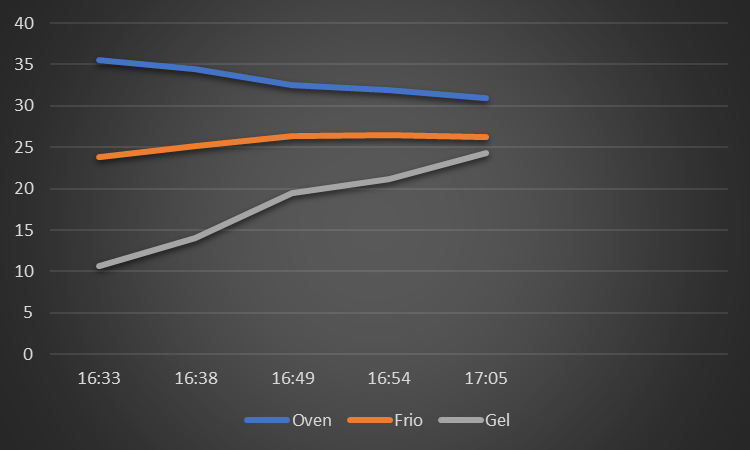
Here the gel pack is 10.7 degrees Celsius, the Frio pouch is 23.8 degrees Celsius, and the oven is 35.5 degrees celsius.

The Results

Thanks to the magic of Excel we can see how the two pouches fared. The oven temperature, which had previously reached the target temperature, was slowly dropping but remained above 30 degrees for the whole time. The Frio pouch, with the oven’s heat being used to turn the Frio’s water to steam, was holding a reasonably even temperature. The gel pouch, with nothing but insulation, slowly increased in temperature, catching up to the Frio after about 30 minutes, despite the 15 degree head start.

To be honest I was not sure the Frio pouch would work as well as it did as the oven was closed and, therefore, once the air inside the oven was saturated with moisture, the Frio would no longer be able to cool but for the 30 minutes it continued to work.

Conclusions

First of all I was really impressed the results came out as well as they did, showing the characteristics of the two pouches. For my money, if I was expecting to carry insulin for an extended period of time in high heat, I would likely look to a pouch that uses evaporative cooling. I would also invest in a MedAngel so I could check the temperature inside the pouch at any time and be alerted if things were going astray. Gel is a much cheaper option, of course, so, for short excursions, it will work fine. You could also, if you had a large enough pouch, put a cooled gel pouch inside a Frio pouch and gain a double benefit. As long as the Frio pouch is on the outside this should work fine.

EASD 2021: Reconciling the International Consensus Reports for LADA and Type 1. Part 1: Diagnosis

Thanks to the generosity of #dedoc°, I recently had the privilege of virtually attending the world’s largest Diabetes conference: EASD 2021. Arguably the biggest news at the conference was an international consensus on the diagnosis, treatment, and management of Type 1 Diabetes. This is a comprehensive guide, backed by the American Diabetes Association (ADA) and the European Association for the Study of Diabetes (EASD), which should, in my opinion, be the bible for health care professionals and for guiding health-related government policy.

Interestingly, last year an international consensus was released for the diagnosis, treatment, and management of LADA. I wrote a blog on it at the time going through the details. While not the same authors, nor directly endorsed by ADA/EASD, one would hope the two reports are broadly aligned in their approach given LADA is usually considered a sub-group of Type 1. In fact they are but there are differences at the edges and I raised this during the conference.

Rather than wait for the academics I thought I would go through the reports and see if I could make some headway. I will split this up into at least two parts with this one covering the diagnosis of Type 1 and of LADA.

As usual, there is the tl;dr section at the end for those that want to cut to the chase.

Diagnosing LADA

The first problem is there is no simple categorical feature of LADA. At diagnosis it shares features with “classic” Type 1 and Type 2.

So, while we can make a good guess at diagnosis, there is room for error. The report goes on to weigh up the various factors which can be used for assessment and comes up with the following flow chart.

So, first we test for the auto-antibody GADA. If it is positive, the person has Type 1 (LADA) diabetes and their treatment is then determined by their C-peptide levels. The report is vague on whether the C-peptide test is fasting, random time, or post-prandial (after a meal).

If the GADA screening is negative, the report suggests it is likely the patient has Type 2 diabetes and, therefore not LADA (although Type 3c and MODY should be considered). However, if LADA is still suspected, other auto-antibodies such as IA-2A, ICA, and ZnT8A can be screened. If these are positive, we are back to a positive diagnosis of Type 1 with treatment being defined by C-peptide levels.

Diagnosing Type 1

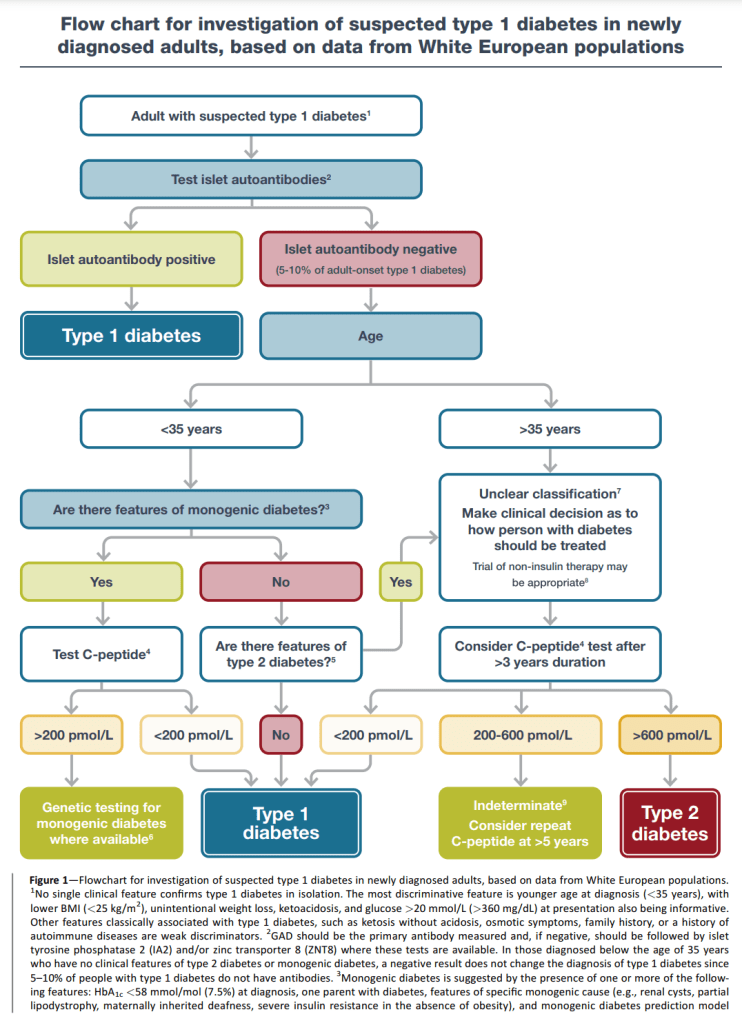
The Type 1 report also weighs up the various factors in diagnosing Type 1 compared to other Types, such as Type 2 and MODY and comes up with this flow chart.

The first statement, like the LADA report, is that no one feature is categorical, not even auto-antibodies (which can be present in other conditions). So, assuming something, such as DKA, has triggered the investigation, testing for auto-antibodies is, like the LADA report, the first place to look. Also, similar to the LADA report, the Type 1 report considers GADA as the first auto-antibody to screen for, followed by the others. If the test is positive, the patient is considered to have Type 1 diabetes.

If the test is negative (as can be the case in 5-10% of people with Type 1), age is the next consideration. For patients over 35 years old, it is not obvious what Type of diabetes they have. The suggestion is assume Type 2 unless there is suspicion of a different Type e.g. Type 3c, but monitor closely for a rapid deterioration in insulin production. After 3 years, test their C-peptide levels (“a random C-peptide measurement (with concurrent glucose) within 5 hours of eating”) and if they are very low (less than 200pmol/L) then they are considered to have Type 1 diabetes. If the C-peptide levels are high (greater than 600pmol/L) the patient is considered to have Type 2 diabetes. If their C-peptide levels are between these two extremes, the recommendation is to re-test in 5 or more years.

For patients who test negative for auto-antibodies and are less than 35 years old, if MODY is suspected, test the C-peptide and if greater than 200pmol/L, perform genetic testing for MODY. If the C-peptide is less than 200pmol/L, the patient is considered to have Type 1 diabetes. Where MODY is not suspected, and there are no indications of “classic” Type 2, the patient is considered to have Type 1 diabetes. While not obvious what the conclusion is for patients with a C-peptide greater than 200pmol/L, one would assume they follow the same path as those over the age of 35.

Reconciling the Two Consensus Reports

The Type 1 flow chart is more complex so we will use this as the foundation and modify it, if required, to align with the LADA flow chart.

In both reports it is directly acknowledged there is no categorical feature to define Type 1 or LADA. For the purposes of diagnosis, this means there must be a reason we are testing for diabetes in the first place. The Type 1 report suggests “unintentional weight loss, ketoacidosis, and glucose >20 mmol/L (>360 mg/dL) at presentation…Other features classically associated with type 1 diabetes, such as ketosis without acidosis, osmotic symptoms, family history, or a history of autoimmune diseases are weak discriminators.”

Assuming some kind of indicator of diabetes is in place, both reports call for screening for the GADA auto-antibody. If this fails, following up with the other indicative auto-antibodies. If any of these are positive then we have a diagnosis of Type 1 and, depending on the C-peptide level, treatment may differ. Given we are dealing with diagnosis and not treatment in this post, let us move to the case of a negative auto-antibody test.

For the LADA consensus report, once all of the auto-antibody tests come back negative, the conclusion is the patient is Type 2. However, the Type 1 consensus report does not give up so easily. As mentioned in the previous section, if the person is under 35, and there is no indication of MODY or Type 2 (high BMI, no DKA and less severe hyperglycaemia), the conclusion is the patient is likely to have Type 1 diabetes.

This last part, where the patient is negative for auto-antibodies, is probably the biggest departure in diagnosis between the two flow charts. Given there is a far higher rate of misdiagnosis of Type 1/LADAs as Type 2 than the other way around, my preference would be to side with the Type 1 report’s process and conclusions. As we will see in my future post on the treatment recommendations of the two reports, the treatment for a person with Type 1 and high C-peptide levels (as can be the case for LADAs), and the treatment for people with Type 2 is quite similar with main difference being the exclusion of sulfonylureas which can accelerate a person with LADA’s progression to insulin dependence.

tl;dr

The two consensus reports are pretty similar with the Type 1 report being the more comprehensive. The main difference is for people who test negative for auto-antibodies. For the LADA consensus report, it is assumed they have Type 2 diabetes whereas the Type 1 consensus report assumes, if there are no indications of MODY or Type 2, the patient likely has Type 1 and should be treated accordingly.

Therefore, whether someone is suspected of having Type 1 diabetes or are part of the LADA sub-group, the Type 1 consensus report’s flow chart is a good guide for accurate diagnosis. The main steps of this flow are:

  • Determine there is a reason to suspect some form or diabetes e.g. unintentional weight loss, ketoacidosis, and glucose >20 mmol/L (>360 mg/dL) at presentation
  • Screen for GADA auto-antibodies
    • If positive, the patient has Type 1 diabetes
    • If negative and under 35
      • Consider the possibility of MODY and, for a sufficiently high C-peptide level, test if suspected. If negative for MODY (presumably) treat them as if they were negative and over 35 (see below)
      • Consider the possibility of Type 2. If the presentation is consistent with Type 2 (high BMI, no DKA and less severe hyperglycaemia) then diagnose them as if they were negative and over 35 (see below)
      • If the presentation is not consistent with “classic” Type 2 diabetes, assume they are Type 1 and treat accordingly
    • If negative and over 35
      • Consider the possibility of other Types but, if there are no other indicators, assume Type 2 diabetes but monitor closely for a rapid drop in insulin production. Test C-peptide levels in 3 years (“a random C-peptide measurement (with concurrent glucose) within 5 hours of eating”). If the C-peptide levels are high, the patient is considered to have Type 2 diabetes, otherwise re-test in 5 or more years

What Is Your (Diabetes) Type? A Guide For Those Suspecting Misdiagnosis

In my last blog I wrote about the different Types of diabetes. In this blog I will dig a bit deeper to create a scorecard so you can see how ‘typical’ you are and, if you are Type 2, give you a way to see if there is a possibility of misdiagnosis.

I am going to ‘borrow’ an idea from “Think Like a Pancreas” and have a tl;dr section at the end. If you want a quick summary to see if it the blog is worth the time to read, you know where to go.

The Prevalence of Misdiagnosis

Why am I so passionate about the possibility of misdiagnosis? Because it happens a lot. It is estimated that approximately 80% of MODY/NDM diabetics are misdiagnosed as Type 1 or 2. For LADA, misdiagnosis could be as many as 20% of Type 2s, and one study of 2 million diabetics showed that 97% of the Type 3c diabetics had been misdiagnosed as Type 2.

Why is it important? Because treatment, while not defined by Type, is informed by it. For MODY/NDM, the insulin production machinery is broken on a genetic level and for different gene mutations, the most effective treatment is well understood. Trying generic Type 2 treatments will, at best, be as effective but more likely be less effective. For Type 3c, the physical damage to the pancreas means alpha and beta cells are damaged and so it is not just insulin production that is affected. Treatment should account for this. For LADAs, drugs which work the pancreas harder, while appropriate for Type 2s will destroy the pancreas’ beta cells quicker and make the patient insulin-dependent so much quicker.

From a patient’s health perspective, a poorly targeted treatment means blood sugar control will not be managed as well as it could, leading to a higher risk of long term complications. Misdiagnosis is unfortunate for the doctors but can be devastating for the patient.

The Practical Diabetic’s Type Scorecard

Based on key parameters, it is possible to put together a simple scorecard to steer a clinician towards an appropriate diagnosis. I will focus on Type 1, Type 2, LADA, Type 3c, and MODY/NDM simply because Gestational diabetes is routinely tested for and Type 0 presents very differently to the other Types and is more easily diagnosed. I will also assume, like many of us, the patient has presented with a mild DKA for the first time e.g. thirsty, peeing a lot, lethargy, losing weight etc. so we are at the start of the diabetic journey.

For the purposes of the scorecard I am defining LADA as a Type 1 who still has sufficient insulin production to not be insulin dependent. A Type 1 who requires insulin to remain healthy is, for all practical purposes, a ‘normal’ Type 1, possibly in honeymoon.

The idea is to work out which columns result in a positive score and then get the appropriate definitive tests done.

Type 1Type 2LADAType 3cMODY/NDM
Young (<25)+1000+1
Old (>25)0+1+100
Low C-Peptide+100*+10
History of pancreatic
damage
000+10
First degree relative0+100+1
Insulin resistance0+1+100
TOTAL SCORE

(*) Some links characterize LADA as having a low c-peptide. From my perspective if you are a Type 1 with a low c-peptide to the point you need insulin, you have transitioned, from a treatment perspective, to a (possibly honeymooning) Type 1.

After my first article I got a lot of requests for the sources of my information (a good fraction of that piece came from “Think Like a Pancreas” and “Dr Bernstein” with NCBI and Google searches to fill in the gaps). Given this article could well end up in the face of someone actually qualified in medicine and you may need to fight for that definitive test, I’ll quote my links here:

LADA Characteristics
Some More LADA Characteristics
A paper on LADA and Insulin Resistance
MODY Characteristics
Type 3c Characteristics

These are all from NCBI. NCBI is a collection of peer-reviewed medical papers from around the world and cannot be easily dismissed by a health professional.

Hopefully the terms in the first column are relatively self-explanatory. C-peptide is a measure of your body’s insulin production and obtained from a blood test. “First Degree Relative” means a first degree relative who has some form of diabetes. Insulin Resistance can be determined by examining a patient’s HOMA-IR score (derived from their fasting blood glucose and endogenous insulin). Endogenous just means made by their pancreas as opposed to injected.

So let us run it for a sample patient. In this case I will choose me, two years ago when I first presented with DKA. You can read a bit about this in my About Me blog post.

Type 1Type 2LADAType 3cMODY/NDM
Young (<25)+1000+1
Old (>25)0+1+100
Low C-Peptide+100*+10
History of pancreatic
damage
000+10
First degree relative0+100+1
Insulin resistance0+1+100
TOTAL SCORE02200

The scores suggest either Type 2 or LADA. At the time, the hospital believed I was Type 2 and sent me on my way. It was my family doctor who had the smarts to get the right tests done.

Tests For a Definitive Diagnosis

For Type 1 and LADA, the definitive test is a blood test for the auto-antibodies associated with Type 1 diabetes. In 80-90% of cases these auto-antibodies will be present in the blood. If the progression of the disease is advanced, the immune response may no longer be present making a definitive diagnosis harder.

Assuming the test is positive, the next consideration would be the c-peptide level. If it is still normal/high and blood sugars normal, it may be a case that the patient can be treated similar to a Type 2 with regular monitoring to track the deterioration of the pancreas and the transition to insulin-dependence (a slow progression suggests LADA whereas fast progression suggests a ‘classic’ Type 1). If the c-peptide is low, the best option may be to simply consider the patient as a Type 1 and treat them accordingly.

For Type 3c diabetics, a scan of the pancreas will reveal the damage and provide a definitive diagnosis. With a better understanding of the underlying pathology, treatment can be appropriately designed.

For MODY/NDM, a genetic test will provide a definitive diagnosis. As mentioned before, the optimal treatment for the common variants of MODY are known so it is easier to treat and manage the disease once it is diagnosed. This paper reviews in finer detail some of the symptoms of the different forms of MODY as well as the first-line treatments.

tl;dr

There is a lot of misdiagnosis when it comes to diabetes with many Type 2s (and a few Type 1s) being put in the wrong bucket. The right diagnosis means the treatment can be tailored appropriately to ensure the best long-term outcome for the patient.

Using a simple scorecard we can inform the diagnosis and get the right tests done for a definitive answer.

The Types of Diabetes

Diabetics usually know of two Types of diabetes (imaginatively called Type 1 and Type 2). Not surprisingly, most diabetics in the world also fall under one of these two Types but there are others. In fact there are at least 6.5 Types (the half will be explained a bit further down) and not a complete consensus among the world’s diabetes associations. I will focus on the ones where debate in minimal.

The List

For those who do not like to read, here is the list of Types. The rest of this blog will go into detail about each of them, how they are derived, diagnosed and treated.

  • Type 1: About 10% of all diabetics
    • LADA, aka Type 1.5: A subcategory of Type 1
  • Type 2: Almost all of the other 90% of diabetics
  • Type 3c: 0.5-1% of all diabetics (many others wrongly diagnosed as Type 1 or 2)
  • MODY/NDM: 0.24% of those with diabetes
  • Type 0: 1 in 2 million people
  • Gestational: Approximately 13% of pregnant women (1 in 7)

What Makes a Type?

Diabetes Types are NOT classified by how the disease presents itself. This is important because it means the Type does not solely dictate how to treat the disease. Diabetes Types are ‘etiological’. This is a fancy word which means they are classified by the cause.

Type 1

Type 1 diabetes is an auto-immune disease. This simply means the body’s immune system attacks the beta cells of the pancreas. How the immune system gets confused and attacks the body is not yet known. So, while the cause of Type 1 diabetes is known (the immune system) the cause of the cause (why the immune system is broken) is unknown.

Many websites out there characterize Type 1 as “not being able to produce insulin” but this is not the full story. As mentioned, diabetic Types are etiological so while most Type 1s produce little to no insulin (because the immune system is very good at its job), there are Type 1s, like me, who still produce enough insulin to live a relatively normal life.

In terms of diagnosis, when the patient first shows symptoms, a blood test for the auto-antibodies (the parts of the immune system which attach the pancreas) will confirm it is Type 1. If the person has been a diabetic for many years, as the beta cells of the pancreas are mostly destroyed, the immune response will be minimal, making a definitive diagnosis harder.

For treatment, while the patient is in ‘honeymoon’ (where their body can still produce some insulin) they may only need pills and a low carbohydrate/low GI diet to keep their blood sugars under control. However, eventually, the honeymoon will pass and they will need to inject insulin.

Type 2

Type 2 is the most common Type of diabetes and the cause is unknown. This is the bucket all diabetics fall into when the cause cannot be discerned and as this is literally 9 out of 10 diabetics speaks strongly to the fact that we are only beginning to understand this disease and what causes it. Sadly, largely due to unawareness of the various Types in the medical community, there is much misdiagnosis when it comes to a person’s ‘Type’ with far too many being incorrectly dumped into the Type 2 category.

A ‘typical’ Type 2 cannot make enough insulin to meet their body’s needs. The pancreas is limited in its production and the cells of the body do not use the insulin efficiently (insulin resistance). Like Type 1s, the beta cells will show damage in Type 2 patients but the cause of the damage is unknown. One theory is the immune system temporarily attacks the pancreas but then stops, causing partial damage, but this has not yet been proven.

A common myth is that Type 2 diabetes is caused by ‘lifestyle factors’ i.e. eating unhealthy food, being overweight and not exercising. This is completely untrue. Type 2 is associated to things like obesity but it is not the cause. Where the association likely comes from is that a common cause of insulin resistance is fat deposits around the organs (visceral fat). So, if you are overweight, you may be contributing to your insulin resistance. However the underlying production limitation is still there. While reducing your carbohydrate intake and losing weight may get you off the medications, you are not cured, but simply in remission. Your impaired insulin production is still there; you are simply not testing the limit any more.

An analogy would be to suggest that asthma is caused by running because when some people run, they get an asthma attack. While asthma attacks are associated with exertion, the cause is completely separated; the exertion simply tests the limits imposed by the disease.

Unlike Type 1, there is a strong genetic component to Type 2 (although there is no genetic test for the disease). Type 2 runs in families and is significantly more prevalent in some areas of the world more than others.

Given the cause if unknown, diagnosis comes from exhausting the possibility of the other Types (or it should!) and giving the patient a glucose tolerance test to establish they have an abnormal response when processing sugars.

While insulin is sometimes needed, Type 2 is usually managed through pills, diet, and exercise. Progression of the disease is extremely slow and many Type 2s never require insulin to stay healthy.

LADA (Type 1.5)

LADA is also an auto-immune disease and, therefore, is a sub-category of Type 1. LADA stands for ‘Latent Autoimmune Diabetes of Adulthood’ and what makes LADA different to ‘typical’ Type 1 is the rate at which the disease progresses. This is what the word ‘latent’ means and why LADA is different to typical Type 1. While a typical Type 1 will be on insulin somewhere between immediately to a few weeks after diagnosis, LADA patients can survive without insulin for years.

Generally, LADAs are diagnosed later in life (for me it was at the age of 43) whereas ‘normal’ Type 1s are diagnosed much younger. Because LADA affects older people and the patient may not require insulin straight away, it is often misdiagnosed as Type 2. A simple blood test is all it takes to separate the LADAs from the Type 2s.

This was the test that the hospital failed to do in my case. As a male in his early 40s with a bit of extra padding, the ‘experts’ simply assumed I was Type 2. As LADA eventually leads to ‘classic’ Type 1 where the body no longer produces insulin, it differs to Type 2 which often never progresses to such a state. Therefore, the treatment of LADA is different to Type 2 because the focus is on preserving beta cells and prolonging the honeymoon, whereas in Type 2s it is assumed the remaining beta cell population will stay mostly constant for the rest of the patient’s life.

This misdiagnosis leads to many cases where someone who has been told they are Type 2, gets sicker and sicker as the medications become less effective. Often the misdiagnosis is eventually found but only after the patient has been ravaged with diabetic complications which may last the rest of the life e.g. eye damage, organ damage, nerve damage etc. All it takes is a simple blood test when the disease first presents itself to get the diagnosis right and to save the patient’s quality of life and a fortune in medical consultations and treatments.

Type 3c

The first of the lesser-known Types, Type 3c is NOT auto-immune but is where the pancreas is damaged by something else e.g. cancer, pancreatitis, cystic fibrosis, surgery etc. The damage may have also happened years before symptoms begin showing.

Given the cause is different we begin to see that this is important in how we approach the disease. Whereas the immune system selectively targets the beta cells (the cells of the pancreas which produce insulin) but usually ignores the alpha cells (which produce other hormones used for blood sugar regulation), damage caused by cancer or a car accident is less selective. Therefore, treatment which assumes the patient is Type 1 or 2 may miss the mark and, like the misdiagnosis of LADAs, may lead to diabetic damage before the error is revealed.

Diagnosis is through examining the patient’s history to see if there is a likelihood of damage and scanning of the pancreas to see the physical damage.

MODY/NDM

MODY (Maturity Onset Diabetes of the Young) and NDM (Neonatal Diabetes Mellitus) are monogenic forms of diabetes. Monogenic simply means caused by one broken gene. The name ‘Maturity Onset Diabetes of the Young’ is similar to terms like ‘Juvenile Diabetes’ and ‘Adult Onset Diabetes’ in that they come from a time when our technology was unable to definitively define the cause. Today, these terms are limited in their meaning but continue to hang around. I, for example, was diagnosed with ‘Juvenile Diabetes’ in my early 40s.

Most cases of MODY/NDM involve one of three specific genes but 11 gene mutations have been discovered so far. As MODY/NDM are genetic they strongly carry down family lines. While as a Type 1, your children have something like an additional 10% risk of having the disease, with MODY/NDM they have a 50% risk, 1 in 2.

The mutated gene means that a patient with MODY/NDM cannot produce insulin effectively and medication which seeks to stimulate the beta cells in some fashion may be useless in MODY/NDM patients. There is also a form of MODY (Glucokinase MODY) which affects blood glucose regulation but the principle that treatment due to misdiagnosis may be ineffective or counterproductive remains the same.

As MODY/NDM are strongly genetic, the patient’s broken beta cell machinery goes into operation at birth (arguably before birth but the mother can help compensate). For NDM, symptoms appear in the first 6-12 months of life (it is very rare for Type 1 to make an appearance this early), while for MODY symptoms usually appear in adolescence.

Definitive diagnosis comes from genetic testing, which is readily available. While misdiagnosis is, again, common, the correct diagnosis is vital as different forms of MODY/NDM respond to different drugs or, in the case of Glucokinase MODY, no treatment may be needed at all (Glucokinase MODY has the patient run a slightly high blood glucose but often not dangerously so). The other reason correct diagnosis is important is because of the risk to a patient’s children of having the same disease. Knowing this means it can be tested for and treated before complications arise.

Type 0 Diabetes

This disease is also called Glycogen Storage Disease Type 0. While also caused by genetic mutations, rather than affecting the machinery that produces insulin, it affects the machinery which uses the insulin to move blood sugar into cells for storage.

One of the things insulin does is move glucose out of the blood and into cells. Excess glucose is usually converted to ‘glycogen’ and stored in the cells (mainly in the liver but also in muscles) as an emergency energy source in times of exertion. In patients with Type 0, they cannot produce glycogen and therefore they have no energy backup.

The upshot of this is a patient with Type 0 can faint doing something as simple as climbing a set of stairs. Because there is no backup energy source and because it is hard to shift excess glucose out of the blood, a Type 0 patient will have wildly fluctuating blood glucose levels and the usual diabetic treatments (insulin and glucagon injections) are completely ineffective. If you think you have it tough as a Type 1, consider the plight of the Type 0.

As the disease presents in a very different way to the other Types e.g. fainting when climbing stairs, misdiagnosis is less common. Treatment is difficult and the best protocols are still being determined.

Gestational Diabetes

As the name suggests, gestational diabetes occurs during pregnancy so this one is exclusively female. The mechanism is broadly understood; to grow a baby, glucose needs to reach the fetus. To make this happen, the woman’s body releases hormones which increase insulin resistance in her own body, limiting access to glucose and allowing it to get to the baby.

With increased insulin resistance, the pancreas needs to release more insulin to keep up with the woman’s energy demands (up to three times as much in fact) which can test the pancreas’ limits and lead to diabetes. Excess glucose in the blood can make the baby grow excessively, leading to birthing complications but can also damage the baby leading to miscarriage or stillbirth so it is important that Gestational Diabetes is managed during pregnancy and, thankfully, screening for it is common.

Once the baby is born and the pregnancy hormones disappear, the diabetes usually goes as well. However, in some cases, the damage is done and the diabetes remains, generally classified as Type 2 and treated as such. Arguably, the cause is known so it is not really Type 2 and is a continuation of Gestational Diabetes.

What is Your Type?

If you are a Type 2 and your treatment plan is not working well, it is worth considering that you may have been misdiagnosed. If, after reading the above, you feel you may be a candidate for a different Type, reach out to a medical professional to discuss your concerns. While medical professionals hate Dr Google and well meaning blogs, it is your life and you who will have to live with the complications if their guess was wrong. They can organize the tests to make a definitive diagnosis.